Akila Expands R&D Hub in Vietnam to Drive AI-Powered Cognitive Buildings

March 12, 2025

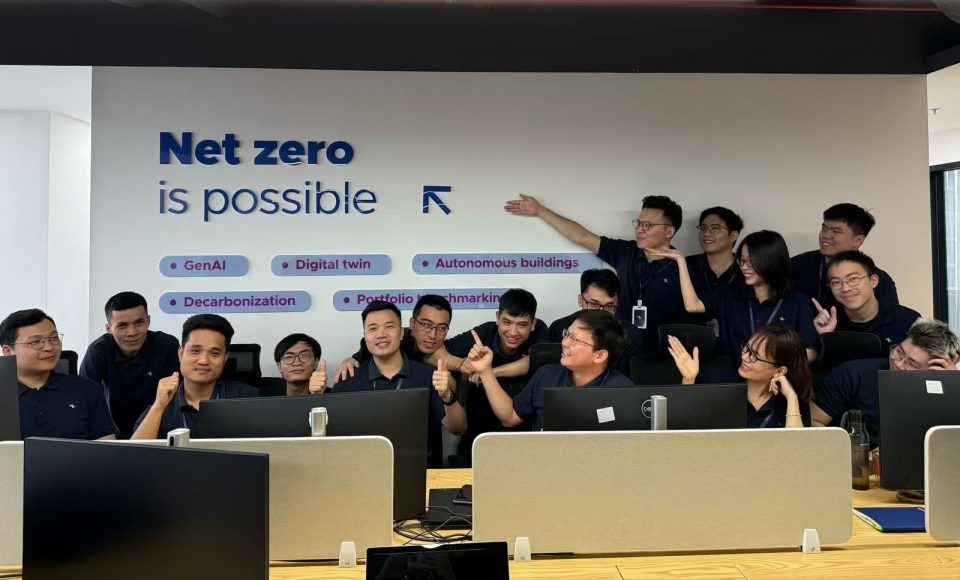
This month marks a major milestone for Akila as our R&D team in Vietnam moves into a new, expanded location in Hanoi. Established in 2023, this hub has rapidly become a driving force behind our AI innovation, pushing the boundaries of smart building technology.

With the rapid urbanization of cities across the world, the demand for intelligent, data-driven real estate solutions is greater than ever. At Akila, we are shaping the future of Cognitive Buildings, leveraging cutting-edge AI and strategic partnerships – such as our collaboration with NVIDIA, to accelerate the transformation of the built environment.
Why Vietnam? A growing hub for AI innovation

Vietnam’s thriving tech ecosystem, highly skilled talent pool, and strong government support for digital transformation make it an ideal location for an R&D hub dedicated to AI and real estate technology. Our team in Hanoi is tackling some of the biggest challenges in the industry, developing solutions that will redefine how real estate portfolios are managed worldwide.

Pioneering AI-driven real estate intelligence

Our Vietnam R&D team is at the forefront of several key AI initiatives that will shape the next generation of smart buildings:

  • Generative AI & Large Language Models (LLMs) – We are integrating generative AI and LLMs into Akila’s platform to create a truly unified real estate data ecosystem. This enables users to access real-time insights through natural language queries, making data-driven decision-making faster and more intuitive.
  • Advanced real-time simulations – We are developing AI-powered simulations that optimize critical building performance factors, including airflow, thermal comfort, lighting efficiency, and human traffic patterns. These simulations help property owners enhance energy efficiency and occupant experience while reducing operational costs.
  • Scaling AI for district-wide optimization – Beyond individual buildings, our AI-driven solutions are expanding to entire urban districts. By simulating and analyzing real estate data on a city-wide scale, we can optimize energy use, sustainability performance, and operational efficiency across multiple properties.

Building the future of smart real estate

Our vision is to transform the real estate industry by making every building a Cognitive Building—one that continuously learns, adapts, and optimizes its operations using AI. The work being done in our Vietnam R&D hub is a crucial part of this mission, driving scalable, AI-powered solutions that redefine how we interact with the built environment.

As we continue to expand our R&D capabilities, we invite innovators, technologists, and partners to join us on this journey. If you’re in Hanoi, stop by and say hello—we’d love to connect and share more about the exciting work happening at Akila.

For a more detailed breakdown of how AI can be used to enhance the building lifecycle, check out this blog post.

Related Articles
Akila and Ubicité (Altitude Group) announce a strategic alliance to accelerate the digital and sustainable modernization of public buildings in France

Akila and Ubicité (Altitude Group) announce a strategic alliance to accelerate the digital and sustainable modernization of public buildings in France

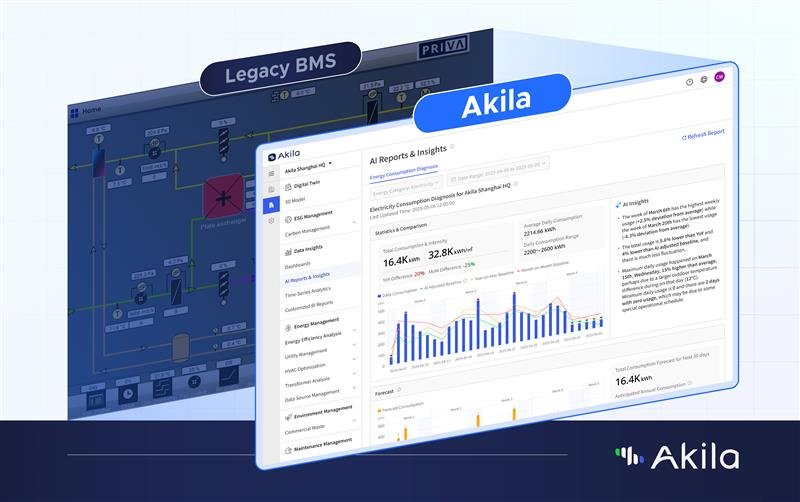
Why traditional BMS is costing you 25% more energy, and how AI HVAC optimization changes the game

Why traditional BMS is costing you 25% more energy, and how AI HVAC optimization changes the game

Akila joins WEF’s Digital Twin Cities Advisory Committee

Akila joins WEF’s Digital Twin Cities Advisory Committee

Take the next step with Akila

If you want better from your buildings, our team is here to help. Let’s set up a call to discuss your needs and show you how Akila works, from deploying digital infrastructure to optimization.

910-Product-page
Secondary ~ Request Demo Simple

The role of Building Management Systems in improving occupants’ safety

December 23, 2024

Building Management Systems (BMS) are centralized control systems that allow building managers to monitor, manage and automize different various functions such as HVAC, lighting or fire and safety. They collect data from sensors and devices installed in buildings and provide building managers or operators with a central interface for monitoring and controlling all these systems.

BMS have become essential to control energy efficiency, but they can be used for much more, like ensuring the safety of building occupants for example.

Occupants’ safety is a top priority for building owners and managers. By being able to quickly identify potential hazards, BMS can enhance safety by automating emergency responses and allowing building managers to address those issues before they escalate to something worse. They provide a safer and more responsive environment for occupants.

Real-time monitoring and alerts

By continuously monitoring building environment, BMS can give indications about the air quality or the temperature of a building, but BMS can also give other indications such as smoke detection. When the system detects an anomaly, or a condition that is out of what is considered safe or normal levels, it can then send an alert which will allow building managers to always be ahead of any issue and to take actions before it gets to a level where the safety of the occupants is at risk.

If BMS can trigger alerts, they can also be integrated with fire and emergency response systems, such as fire alarms, sprinkler systems, and emergency lighting. It’s known that rapid interventions are crucial in situations involving toxic gases or fire risks, as every second can make a change.

BMS will enable to create a coordinated response emergencies allowing for rapid detections but more than anything immediate actions such as unlocking exit doors, or even directing occupants by activating emergency lighting and therefore significantly improving overall safety for occupants.

Enhanced response to environmental threats

The sensors connected to BMS also allow detecting any environmental threat such as a gas or water leak, or CO2 level in a building. These can be challenging to detect without the help of technology.

A gas or a CO2 leak won’t only impact on the quality of the air, it could also lead to an explosion, as much as a water leak could end up with a flooding in the building causing damages to other assets.

These environmental threats could become serious threats to occupants. BMS’s proactive response enhances health and safety by minimizing occupants’ exposure to harmful conditions and reducing the risk of property damage. This capability to manage risks in real time can help protecting people and infrastructure, ensuring safer and more resilient buildings.

Access control and security monitoring

Access control and security monitoring is another area where BMS can help.

When integrated with access control systems or CCTV for example, they can enhance building security: these systems will allow building managers to regulate entry points and manage access control.

If an unauthorized entry is detected, BMS will be able to restrict access by locking doors this time or by giving security teams the exact location of the issue, but it can also give more information to security teams : it could tell whose badge has been used for example, or activating CCTV in the area of the intrusion, allowing building managers to have a record of those intrusions and to have evidence if needed in the future.


Building Management Systems (BMS) have become essential tools in modern building safety management. They offer a proactive, data-driven approach to ensure occupant. By delivering immediate alerts, coordinating automated emergency responses, and managing access control, BMS provide building owners and managers with powerful ways to enhance building security and prevent potential hazards. Beyond improving energy efficiency and reducing operational costs, BMS offer critical benefits in health, safety, and risk management for commercial and residential buildings alike. For those focused on creating safer, more resilient buildings, investing in BMS technology is a strategic choice to protect both people and property.

Related Articles
Smarter Manufacturing Starts with Unified Data 

Smarter Manufacturing Starts with Unified Data 

Saint-Gobain deploys Akila at its research center in Shanghai to reinforce sustainability achievement and employee wellness 

Saint-Gobain deploys Akila at its research center in Shanghai to reinforce sustainability achievement and employee wellness 

Akila commits to SBTi Net-Zero Standard, joins Business Ambition for 1.5°C

Akila commits to SBTi Net-Zero Standard, joins Business Ambition for 1.5°C

Take the next step with Akila

If you want better from your buildings, our team is here to help. Let’s set up a call to discuss your needs and show you how Akila works, from deploying digital infrastructure to optimization.

910-Product-page
Secondary ~ Request Demo Simple