Building the next generation of smart campuses: Energy, operations, and video intelligence in education

December 11, 2025


Educational institutions today face a unique combination of operational pressures. Campuses are growing more complex to manage, students and faculty expect safer and more responsive environments, and administrators are under increasing pressure to reduce energy consumption and meet sustainability targets. As these needs expand, campuses must look for tools that provide better visibility, faster decision making, and long-term resiliency.

Akila supports this transformation by bringing campus operations, energy management, maintenance, and video intelligence together into a single, unified platform. For schools, universities, and research facilities, this creates a clearer, more actionable understanding of how their campuses are performing in real time.


Modern challenges across campus operations

Most educational environments face a similar set of hurdles. Large campuses often rely on aging or inconsistent infrastructure, with HVAC, utilities, and equipment spread across many different building types. Energy consumption is high, especially in spaces such as labs, dormitories, and lecture halls. Maintenance teams struggle with limited visibility and reactive workflows. On top of this, institutions need faster ways to understand what’s happening across campus – whether an incident needs review, a crowded area needs attention, or a room’s usage patterns suggest a better scheduling or energy strategy.

These challenges create inefficiencies that impact sustainability, campus experience, operational continuity, and planning.


A unified digital foundation for smarter campuses

Akila addresses these challenges through a holistic approach that connects building systems, equipment data, IoT devices, and video sources into a single platform. This gives administrators, facility teams, and safety staff a shared operational picture of the entire campus.

Optimized energy and HVAC performance

AI-driven analytics help institutions better understand how their buildings consume energy, alert teams to anomalies, and automatically adjust HVAC systems according to occupancy and usage patterns. Whether for classrooms, research spaces, or residential buildings, Akila delivers more efficient performance while still maintaining comfort and reliability. Clear energy baselining and carbon tracking also help institutions align to sustainability commitments and regulatory requirements.

Predictive maintenance and digital twin visualization

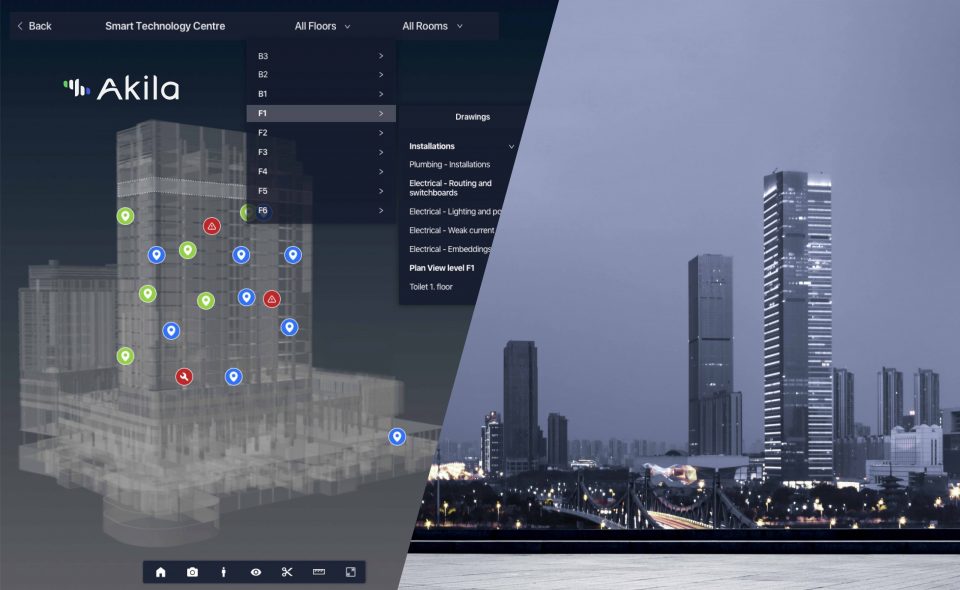
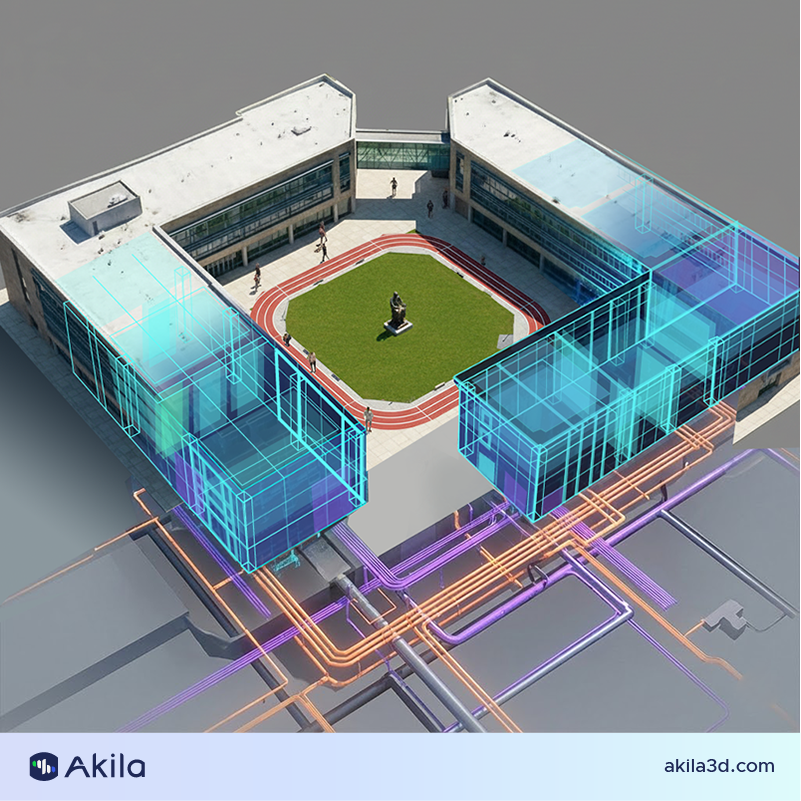
A campus-scale digital twin brings every asset and building into a clear 3D view, allowing teams to quickly locate equipment, understand system relationships, and respond faster. Condition-based maintenance ensures that faults are detected early and repairs are scheduled before they disrupt classes or operations. As campuses expand, this digital foundation becomes a critical tool for planning and long-term lifecycle management.

Video analytics for faster insights

As campus environments grow more dynamic, the ability to quickly understand what happened in a specific area or timeframe becomes increasingly important.

Akila integrates Video Search and Summarization (VSS) to make video data more accessible and efficient to use. Instead of manually reviewing long footage, teams can use AI to instantly search for relevant moments or generate concise summaries around an event window or location. This supports faster incident verification, better coordination, and a clearer understanding of activity patterns across the campus.

VSS is not positioned as surveillance technology – it is an operational intelligence tool that helps education institutions gain insights quickly, improve response times, and make more informed decisions about space utilization and campus planning.


Creating better learning environments

When energy management, maintenance, and video intelligence operate through a unified platform, campuses experience tangible improvements.

  • Learning spaces stay more comfortable and consistent.
  • Maintenance issues are addressed proactively rather than reactively.
  • Activity patterns reveal how buildings are truly used, supporting smarter scheduling and resource allocation.
  • Campus teams gain faster access to critical information during incidents or peak activity periods.
  • Sustainability strategies align more closely with real operational data.

These outcomes directly support the core mission of education institutions: providing safe, healthy, and empowering environments for students and staff.


Designed to scale across diverse campus environments

Akila is designed to scale seamlessly from single buildings to multi-campus portfolios. Institutions can standardize energy reporting, maintenance workflows, and operational practices across all locations while maintaining the flexibility needed for different building types and usage patterns.

This approach provides administrators with long-term digital governance and ensures consistency even as campuses expand, renovate, or adapt to new operational demands.


Building the future of digital education infrastructure

The future of campus operations will rely on integrated digital systems that combine energy intelligence, predictive maintenance, real-time visualization, and rapid video-based insights. By bringing these capabilities together, Akila helps educational institutions move toward safer, more efficient, and more sustainable campuses — all while empowering teams to make better decisions every day.

Related Articles
Time series analysis: harnessing the power of BMS data

Time series analysis: harnessing the power of BMS data

From Complexity to Clarity: Making Building Data Work for Everyone 

From Complexity to Clarity: Making Building Data Work for Everyone 

Akila Institutions: UTSEUS

Akila Institutions: UTSEUS

Take the next step with Akila

If you want better from your buildings, our team is here to help. Let’s set up a call to discuss your needs and show you how Akila works, from deploying digital infrastructure to optimization.

910-Product-page
Secondary ~ Request Demo Simple

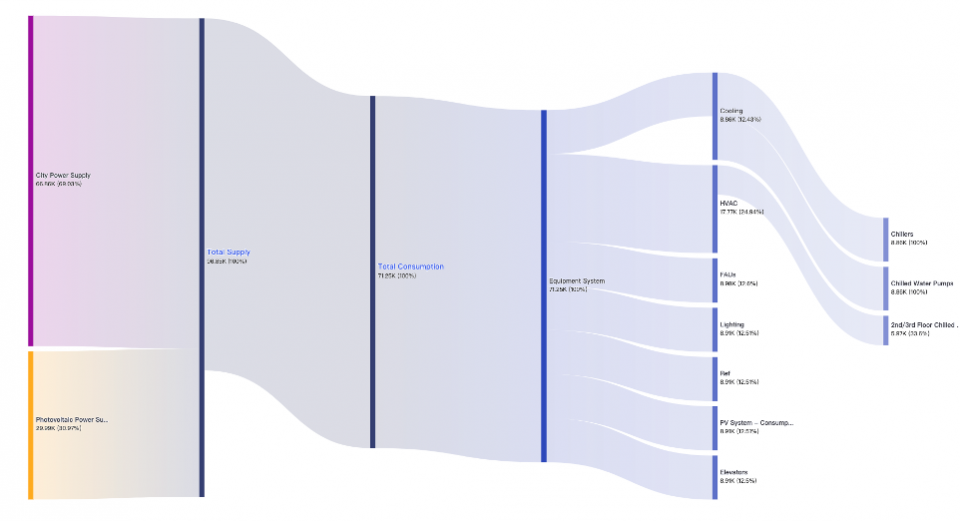
Understanding how energy moves through a building has always been one of the biggest challenges in facility and sustainability management. Data comes from everywhere including utility feeds, renewable systems, sub-meters, sensors, and BMS points,but it rarely comes together in a way that reveals the full picture. Most systems can tell you how much energy a building uses. Very few can show you where that energy comes from, how it’s distributed, and what (or who) is driving the demand.

Akila’s improved Energy Flow Analysis feature is built to change that. By turning fragmented, complex data into a complete, intuitive, and shareable map of energy from supply to final consumption, it gives organizations the clarity they need to understand performance, improve coordination, and take faster, data-backed action.


The problem: Energy data without structure creates blindspots

Modern buildings generate enormous volumes of information. Yet the systems designed to interpret that information often struggle with transparency.

  • Energy supply is split across grid feeds, renewables like PV systems, and sometimes backup generators or batteries.
  • Consumption is scattered across tenants, equipment categories, operating schedules, and zones.
  • Different teams create their own diagrams or spreadsheets, leading to inconsistencies and duplicated work.
  • Portfolio managers struggle to benchmark sites because each building reports energy differently.
  • Facility teams are left reacting to peaks and inefficiencies rather than preventing them.

Without a structured and intuitive way to visualize the entire energy chain, even the best teams are making decisions in the dark.


Introducing Akila’s enhanced Energy Flow Analysis

Akila’s Energy Flow Analysis creates a complete end-to-end map of where your building’s energy comes from and where it goes. Built on top of a detailed digital twin, the feature transforms raw datapoints into a cohesive energy story.

What sets Akila apart is its powerful, flexible IoT integration framework. Akila seamlessly connects to a wide variety of data sources including electricity meters, water meters, smart sockets, environmental sensors, and legacy BMS points across multiple protocols (MQTT, HTTP API, FTP, and more). This adaptability is the result of years of integrating with both local and global IoT suppliers, as well as third-party and legacy systems.

Whether your building uses locally sourced hardware or a unified global supplier, Akila’s platform ensures that every relevant datapoint is captured, structured, and made available for analysis. Our reusable integration scripts and standardized data models guarantee that energy flow insights are consistent, scalable, and reliable across diverse building portfolios and regions.

With this feature, users can:

  • Visualize the full supply-to-consumption energy journey.
  • See relationships between energy sources, equipment groups, zones, and tenants.
  • Compare real-world flows against expected patterns.
  • Spot anomalies, inefficiencies, and underperforming assets instantly.
  • Align cross-functional teams around one shared view of building performance.

Rather than jumping between multiple sources of truth, teams get a unified energy picture that is accurate, real-time, and actionable.


How it works

Akila begins by integrating data from every relevant source: grid import meters, onsite renewable systems like PV arrays and batteries, tenant sub-meters, equipment-level sensors, and BMS points. This raw data is then cleaned, time-aligned, and mapped into the building’s digital twin, creating a consistent, structured foundation for analysis.

Once the data is organized, Akila generates a dynamic supply-to-load energy flow diagram that visually traces how energy moves through the building – from input sources all the way to consumption by equipment and zones. This intuitive visualization makes it easy to see dependencies, identify bottlenecks, and understand the true story behind energy use.

Finally, these insights are actionable. They inform and enable predictive maintenance, optimization strategies, and reporting workflows, allowing teams to react quickly or even automate responses through Akila’s control features. The result is a unified, real-time understanding of building energy that supports smarter decisions at every level.


Three ways users gain immediate value

  1. Supply side intelligence – Understanding where energy comes from

For buildings using a mix of grid electricity, PV generation, and battery storage, understanding energy supply is critical.

Akila breaks down exactly how much energy is coming from each source and how those sources are being used.

This enables users to:

  • Measure real renewable self-consumption rates.
  • Identify when PV underperforms and diagnose why.
  • Shift loads away from expensive grid periods.
  • Optimize the building’s cost and emissions strategy.

The result is a clearer understanding of your energy mix and more confident decisions around purchasing, scheduling, and sustainability.


  1. Tenant breakdowns – Transparent and fair energy attribution

For multi-tenant buildings, energy transparency is often a pain point. Manual sub-meter reads, inconsistent billing logic, and disputes can eat resources and erode trust.

Akila solves this by breaking down energy consumption by tenant, with data mapped directly to the 3D digital twin.

This gives property managers and owners the ability to:

  • Accurately attribute consumption for billing or reporting.
  • Identify tenants with unusually high load intensity.
  • Highlight savings opportunities specific to each tenant.
  • Reduce disputes through clear, verifiable consumption records.

Improved transparency strengthens landlord-tenant relationships and supports better long-term planning.


  1. Equipment System breakdown – Benchmarking what drives demand

Not all systems contribute equally to a building’s energy load. HVAC may dominate in one building, while pumps or industrial equipment dominate in another.

Akila visualizes consumption by equipment category so users can understand which systems are responsible for which portion of total demand.

This helps teams:

  • Benchmark equipment performance against design values or peer buildings.
  • Spot equipment types with recurring inefficiencies.
  • Prioritize maintenance, upgrades, or operational tuning where it matters most.
  • Detect early signs of equipment degradation through rising energy intensity.

Instead of looking at building-wide totals, operators get detailed clarity on what’s driving energy use.


Why this matters for the future of smart buildings

Energy Flow Analysis closes one of the biggest gaps in building management: the lack of a unified, intuitive, and actionable understanding of how energy moves through the built environment.

With this feature, teams can:

  • Shift from reactive firefighting to predictive planning.
  • Align sustainability and operations teams around shared, trusted data.
  • Build more accurate forecasts and budgets.
  • Support audits, compliance, and ESG reporting with confidence.
  • Unlock new optimization pathways powered by AI and automation.

As buildings grow more complex and energy costs rise, this level of clarity is no longer a nice-to-have — it’s essential.


Related Articles
Akila Expands R&D Hub in Vietnam to Drive AI-Powered Cognitive Buildings

Akila Expands R&D Hub in Vietnam to Drive AI-Powered Cognitive Buildings

Akila joins ZEBOX community to accelerate growth and innovation

Akila joins ZEBOX community to accelerate growth and innovation

Akila x Belimo: A Strategic Collaboration for Smart, Sustainable Buildings

Akila x Belimo: A Strategic Collaboration for Smart, Sustainable Buildings

Take the next step with Akila

If you want better from your buildings, our team is here to help. Let’s set up a call to discuss your needs and show you how Akila works, from deploying digital infrastructure to optimization.

910-Product-page
Secondary ~ Request Demo Simple

Why Semantics and OpenUSD are the Key to Intelligent Digital Twins

October 14, 2025
Related Articles
Australia Mandates Climate Disclosures: What Businesses Need to Know Before 2025

Australia Mandates Climate Disclosures: What Businesses Need to Know Before 2025

Akila’s Transition Plan : “Race to Zero”

Akila’s Transition Plan : “Race to Zero”

Akila at the World Economic Forum: Driving the Future of Digital Twin Innovation

Akila at the World Economic Forum: Driving the Future of Digital Twin Innovation

Take the next step with Akila

If you want better from your buildings, our team is here to help. Let’s set up a call to discuss your needs and show you how Akila works, from deploying digital infrastructure to optimization.

910-Product-page
Secondary ~ Request Demo Simple

Akila and FPT Welcome Hauts-de-France Delegation in Tokyo to Strengthen Franco-Japanese Partnerships in Digital Transformation

September 29, 2025
Related Articles
Schlumberger Indonesia uses Akila Asset to digitalize maintenance management

Schlumberger Indonesia uses Akila Asset to digitalize maintenance management

Scope 3 emissions: challenges and solutions

Scope 3 emissions: challenges and solutions

Feature focus: Real-Time Weather Data Energy Simulation

Feature focus: Real-Time Weather Data Energy Simulation

Take the next step with Akila

If you want better from your buildings, our team is here to help. Let’s set up a call to discuss your needs and show you how Akila works, from deploying digital infrastructure to optimization.

910-Product-page
Secondary ~ Request Demo Simple

 Akila at the AI-xperience Forum in Amsterdam

September 28, 2025
Related Articles
Smarter Manufacturing Starts with Unified Data 

Smarter Manufacturing Starts with Unified Data 

Solar Impulse Label: one year of developing sustainable and profit-driven solutions

Solar Impulse Label: one year of developing sustainable and profit-driven solutions

Energy SUITE: dedicated tools for decarbonization

Energy SUITE: dedicated tools for decarbonization

Take the next step with Akila

If you want better from your buildings, our team is here to help. Let’s set up a call to discuss your needs and show you how Akila works, from deploying digital infrastructure to optimization.

910-Product-page
Secondary ~ Request Demo Simple

Smarter Manufacturing Starts with Unified Data 

September 26, 2025
Related Articles
Carbon neutral buildings are essential for stopping climate change

Carbon neutral buildings are essential for stopping climate change

HVAC efficiency in a time of energy shortages and insecurity

HVAC efficiency in a time of energy shortages and insecurity

Monthly recap : October

Monthly recap : October

Take the next step with Akila

If you want better from your buildings, our team is here to help. Let’s set up a call to discuss your needs and show you how Akila works, from deploying digital infrastructure to optimization.

910-Product-page
Secondary ~ Request Demo Simple

The role of Building Management Systems in improving occupants’ safety

December 23, 2024

Building Management Systems (BMS) are centralized control systems that allow building managers to monitor, manage and automize different various functions such as HVAC, lighting or fire and safety. They collect data from sensors and devices installed in buildings and provide building managers or operators with a central interface for monitoring and controlling all these systems.

BMS have become essential to control energy efficiency, but they can be used for much more, like ensuring the safety of building occupants for example.

Occupants’ safety is a top priority for building owners and managers. By being able to quickly identify potential hazards, BMS can enhance safety by automating emergency responses and allowing building managers to address those issues before they escalate to something worse. They provide a safer and more responsive environment for occupants.

Real-time monitoring and alerts

By continuously monitoring building environment, BMS can give indications about the air quality or the temperature of a building, but BMS can also give other indications such as smoke detection. When the system detects an anomaly, or a condition that is out of what is considered safe or normal levels, it can then send an alert which will allow building managers to always be ahead of any issue and to take actions before it gets to a level where the safety of the occupants is at risk.

If BMS can trigger alerts, they can also be integrated with fire and emergency response systems, such as fire alarms, sprinkler systems, and emergency lighting. It’s known that rapid interventions are crucial in situations involving toxic gases or fire risks, as every second can make a change.

BMS will enable to create a coordinated response emergencies allowing for rapid detections but more than anything immediate actions such as unlocking exit doors, or even directing occupants by activating emergency lighting and therefore significantly improving overall safety for occupants.

Enhanced response to environmental threats

The sensors connected to BMS also allow detecting any environmental threat such as a gas or water leak, or CO2 level in a building. These can be challenging to detect without the help of technology.

A gas or a CO2 leak won’t only impact on the quality of the air, it could also lead to an explosion, as much as a water leak could end up with a flooding in the building causing damages to other assets.

These environmental threats could become serious threats to occupants. BMS’s proactive response enhances health and safety by minimizing occupants’ exposure to harmful conditions and reducing the risk of property damage. This capability to manage risks in real time can help protecting people and infrastructure, ensuring safer and more resilient buildings.

Access control and security monitoring

Access control and security monitoring is another area where BMS can help.

When integrated with access control systems or CCTV for example, they can enhance building security: these systems will allow building managers to regulate entry points and manage access control.

If an unauthorized entry is detected, BMS will be able to restrict access by locking doors this time or by giving security teams the exact location of the issue, but it can also give more information to security teams : it could tell whose badge has been used for example, or activating CCTV in the area of the intrusion, allowing building managers to have a record of those intrusions and to have evidence if needed in the future.


Building Management Systems (BMS) have become essential tools in modern building safety management. They offer a proactive, data-driven approach to ensure occupant. By delivering immediate alerts, coordinating automated emergency responses, and managing access control, BMS provide building owners and managers with powerful ways to enhance building security and prevent potential hazards. Beyond improving energy efficiency and reducing operational costs, BMS offer critical benefits in health, safety, and risk management for commercial and residential buildings alike. For those focused on creating safer, more resilient buildings, investing in BMS technology is a strategic choice to protect both people and property.

Related Articles
Akila Institutions: Fudan – MIT China Lab

Akila Institutions: Fudan – MIT China Lab

HVAC and IEQ: The Hidden Backbone of Global Logistics 

HVAC and IEQ: The Hidden Backbone of Global Logistics 

Meet Akila: Wilfred Leung, Director of Product Design

Meet Akila: Wilfred Leung, Director of Product Design

Take the next step with Akila

If you want better from your buildings, our team is here to help. Let’s set up a call to discuss your needs and show you how Akila works, from deploying digital infrastructure to optimization.

910-Product-page
Secondary ~ Request Demo Simple

Enhancing preventative maintenance: How Akila’s new feature streamlines asset management

October 25, 2024


Preventative maintenance is the proactive approach to equipment maintenance, involving regular inspections, servicing, and repairs to prevent issues before they could occur, ultimately extending asset lifespan.

Akila’s new feature, launched on October 15th, enhances this approach by directly connecting automated alarms to maintenance work orders and inspections, ensuring faster responses and streamlining the asset management process.

By addressing potential problems before they occur and potentially leading to equipment breakdowns, preventative maintenance helps reduce costs, minimize downtime of equipment, and improve operational efficiency.

However, many maintenance systems lack real-time monitoring or don’t implement it well enough to allow for predictive alarms. Maintenance actions are too often delayed due to the disconnect between performance data and the actions needed to address issues, resulting in inefficiencies in the maintenance workflow.

This is where Akila’s latest feature steps in.

The Importance of Preventative Maintenance

In traditional maintenance processes, issues are often only addressed after an issue has arisen and the equipment has therefore failed. This way of working leads to emergency fixes and unplanned downtime, which can disrupt operations, not only for users but also for maintenance teams.

When equipment stops working it also implies costs as it implies downtime and a break in productivity. These costs are higher most of the time than if the equipment had been monitored closely and minor issues had been fixed earlier, leading to no or less downtime.

Preventative maintenance offers a major improvement by focusing on routine inspections and scheduled maintenance. By keeping equipment in optimal working condition, it minimizes unexpected failures and extends the life of assets, making them more reliable and efficient. It also helps ensure compliance with safety standards, further protecting both employees and equipment.

Despite the benefits, challenges in implementing preventative maintenance programs remain, especially because many systems don’t offer real-time monitoring or effective alarm setups. Even when alarms are present, performance data is often siloed from maintenance actions, leading to delays in response times. Without a direct connection between monitoring systems and the teams responsible for repairs, issues may escalate unnecessarily.

This is the gap Akila’s new feature seeks to fill, allowing maintenance teams to act quickly and decisively when alarms are triggered.


Akila’s New Feature: Connecting Alarms to Maintenance Work Orders

Akila’s new feature takes preventative maintenance to the next level by integrating alarm systems with work order creation. Whenever an issue is detected on equipment, action is taken by the system quickly and maintenance teams are informed. This highlight of any issue in real-time allows maintenance managers to assess the situation and quickly initiate the necessary actions.

Here’s how it works: Akila’s platform continuously monitors equipment performance through digital twins. The system is able to detect any malfunction by analyzing the data sent from the sensors. If any malfunction or anomaly is identified, such as a performance anomaly or diminished output an alarm is triggered.

This alarm alerts managers to the issue, enabling them to create a work order that links the alarm directly to the necessary maintenance actions.

By highlighting potential problems as they arise, this system allows maintenance teams to address issues before they escalate into larger, more costly failures. The quick transition from detection to response ensures that no time is lost in addressing potential concerns.

Closing the Loop in Equipment Lifecycle Management

Akila’s new feature not only streamlines maintenance tasks but also provides a comprehensive view of the entire equipment lifecycle, from installation to ongoing maintenance. Continuous monitoring and real-time data give teams the ability to monitor equipment performance closely, ensuring that anomalies are detected and addressed as quickly as possible.

With these insights, maintenance teams can keep an eye on the performance of every single equipment, ensuring that any anomaly will be detected and address in the quicker possible way and prioritize daily work more effectively.

Not only can this feature help the maintenance teams to keep assets in the best condition, but Akila also gives them the tools to manage efficiently their work. Indeed, it provides powerful insights into equipment such as recurring issues helping the teams with decision-making. That way, maintenance teams can plan preventative tasks and inspections, but also prioritize their day-to-day work according to the emergency occurring as they are now aware with the help of alerts.

Akila’s platform also allows them to track the progress of their work order, and coordinate when necessary so the maintenance teams stay ahead of potential problems, preventing disruptions.

This system-wide visibility enhances operational efficiency, helps allocate resources more effectively, and contributes to smoother, more reliable performance.


By linking real-time monitoring and actionable maintenance task, Akila significantly improves preventative maintenance. With this new feature, maintenance teams will now be able to respond swiflty to issues by creating work orders more rapidly as they will now be connected to alarms. As a result, maintenance teams to be more efficient and prevent minor issues from turning into huge breakdowns.

Akila’s platform and its tools are becoming essential as it allows for effective asset management. Its real-time insights give unprecedented control to property managers over their assets, enabling them to detect issues quicker than ever. Akila helps organizations work at their best while protecting their equipment and resources for the future. As the landscape of asset management evolves, integrating such cutting-edge technology will be vital for businesses striving to maintain peak efficiency and ensure long-term operational excellence.


Related Articles
Akila partners with STACS ESGpedia to facilitate green financing

Akila partners with STACS ESGpedia to facilitate green financing

Paris GTC/VIvatech 2025 Roundup

Paris GTC/VIvatech 2025 Roundup

Akila Attends 4th Franco-Chinese Carbon Neutrality Forum

Akila Attends 4th Franco-Chinese Carbon Neutrality Forum

Take the next step with Akila

If you want better from your buildings, our team is here to help. Let’s set up a call to discuss your needs and show you how Akila works, from deploying digital infrastructure to optimization.

910-Product-page
Secondary ~ Request Demo Simple

Introduction to building automation

September 20, 2024

Building automation has come a very long way over the years, leading to what we now refer to as “smart building” technology. Smart buildings leverage a whole range of technology solutions such as Building Management Systems (BMS) / Building Automation Systems (BAS), Energy Management Systems (EMS), Computerized Maintenance Management Systems (CMMS), Integrated Working Management Systems and more to make the day-to-day operation of facilities more efficient.

These systems have revolutionized the operation of facilities by providing enhanced control, reducing waste, improving data quality, and optimizing operations and costs.

In the heart of this evolution, Akila stands out as an all-in-one digital twin data platform for buildings. It integrates every system and sub-system into a single source, eliminating silos and contextualizing each part, process, and performance to the entire building.

Unlike typical BMS and EMS software, the Akila digital twin is designed to work with a wide range of hardware, offering greater flexibility and customization. This complete approach ensures that all aspects of building management are seamlessly integrated, providing a comprehensive and efficient solution for modern smart buildings.

Let’s break it down by each different system to see where Akila excels versus traditional tech.


Building Management System (BMS)

Energy Management System (EMS)

Computerized Maintenance Management Systems (CMMS)

Integrated Workplace Management Systems (IWMS)


Traditional building management systems

In today’s increasingly interconnected world, the efficient management of building operations and energy consumption is more critical than ever. Various systems have been developed to address these needs, each offering unique capabilities and benefits. The four key technologies—Building Management Systems (BMS), Energy Management Systems (EMS), Computerized Maintenance Management Systems (CMMS), and Integrated Workplace Management Systems (IWMS)— play a vital role in optimizing building performance and resource utilization.

These technologies have been shaping the landscape of building and energy management, paving the way for smarter, more sustainable, and highly efficient operational practices. Here is how they work and their benefits:

BMS (Building Management System)

A BMS (also known as BAS or BCS) is a computer-based control system installed in buildings that control and monitors different systems in a building. The BMS system typically integrates multiple systems such as heating, ventilation, air conditioning, lighting, and security into a unified system. This centralized control allows for efficient management of the building’s energy consumption, improves the indoor environment, and helps to ensure the safety of the building’s occupants.

EMS (Energy Management System)

An EMS is a software platform that monitors and controls an organization’s energy usage. The EMS allows organizations to track their energy consumption, identify areas for improvement, and implement energy-saving strategies. The system can integrate with various building systems, such as lighting and HVAC, to provide a comprehensive view of energy usage.

The best use of an EMS is to monitor systems and identify anomalies in energy use. An EMS can identify where and how energy is being wasted. It can measure energy use against a baseline and alert operators when it goes off track. It can also simulate energy use in different scenarios to help with planning operations or projects.

CMMS (Computerized Maintenance Management System)

A CMMS is a software application used to manage maintenance operations and track equipment maintenance. The system provides a centralized database to store maintenance records, schedules, and history and enables the efficient planning and execution of maintenance tasks. CMMS can automate tasks such as work order generation, scheduling, and resource allocation, and can generate reports to provide valuable insights into maintenance operations.

By reducing manual processes and providing real-time data on maintenance activities’ status, CMMS can help organizations improve equipment reliability, reduce downtime, and lower maintenance costs. Additionally, CMMS can help organizations comply with industry regulations and standards, such as OSHA, by providing a clear record of maintenance activities.

IWMS (Integrated Workplace Management System)

An IWMS is a comprehensive software platform that helps organizations optimize their workplace facilities, including real estate, infrastructure and facilities management. IWMS integrates various modules such as space, property, maintenance and sustainability management into one platform. This integration allows for better decision making, increased operational efficiency and better alignment with organizational goals. By providing a complete view of workplace management, IWMS helps organizations to boost productivity, reduce costs and create a more sustainable and efficient work environment.

But the field of building and energy management systems is rapidly evolving, driven by emerging technologies.

Innovation in Building and Energy Management Systems

New technologies like IoT, open APIs, cloud-based storage, artificial intelligence (AI) and machine learning (ML) are also improving the way buildings are managed and maintained:

  • IoT: IoT devices enable real-time monitoring and control of building systems, providing detailed insights into operational performance and energy consumption.
  • API Integrations: Open API integrations facilitate seamless connectivity between different systems and platforms, enhancing interoperability and data sharing.
  • Cloud-Based Storage: Cloud-based storage solutions offer scalable and secure data management, allowing for remote access and real-time analytics.
  • AI and Machine Learning: AI and ML algorithms analyze vast amounts of data to identify patterns, predict maintenance needs, and optimize energy usage, leading to smarter decision-making and increased efficiency.

These innovations are revolutionizing building operations management, driving efficiency, sustainability, and enhanced performance across the industry.


What is Akila?

Akila is bigger than any individual system. It is an all-in-one digital twin data platform for buildings designed to unify and streamline your organization’s operations data. It consolidates real-time data from buildings using IoT sensors or open API integrations, offering a complete view for monitoring and optimizing operations. Akila excels in analyzing building metrics and visualizing performance, enabling you to share insights with both internal and external stakeholders.

Akila’s interoperability and extensibility allow seamless integration with existing and future systems, making it a single source of truth for your building management needs. Furthermore, Akila can go beyond just linking all systems at the individual building level to include an entire property portfolio in the same platform. The level of deep data and scalable deployment provided by Akila is what our customers leverage to optimize ESG performance.

Our platform allows you to monitor, track, and analyze utility usage, providing a deep understanding of resource consumption. By identifying inefficiencies in energy-intensive systems like HVAC, Akila helps you optimize these systems to reduce costs and carbon emissions. With advanced analytical tools, benchmarking, and forecasting capabilities, Akila supports informed decision-making through meaningful interactions with data.

Akila solutions VS traditional systems

Akila VS BMS

Akila brings in the functionality of a BMS and goes even further beyond. We build upon the useful features of a BMS and pair them with a full-picture system that includes more in-depth looks at the inter-relation of different systems and the operations surrounding them. Akila then leverages this BMS data to help businesses meet their sustainability, efficiency, and ESG goals.

For example, when Akila was deployed in a multi-site project for Ikea China, the existing buildings were already using a BMS. These were integrated into the Akila platform, where the data was centralized along with other sub-system data to provide a full-picture look at the site’s performance. Using Akila as a single source of truth led to improved efficiency and a resulting reduction in energy use.

Akila VS EMS

Akila can also provide all the functions of an EMS through just one software suite: Akila Energy. We integrate with EMS systems and provide value added analytics and normalization on top with the Energy SUITE. Akila Energy then works in tandem with other software and hardware (such as BMS and maintenance functions) to provide energy-specific data relating to equipment and operations. This also includes micro-grid assets, such as on-site solar panels and energy storage batteries.

One of the most important energy-related features of Akila is the ability to track energy savings and measure greenhouse gas impact based on Scope 1, 2, and 3 emissions categories. This information is critical when it comes to ESG reporting. Akila allows our customers to use the time normally spent on collecting data to act on improving their emissions impact.

Akila VS CMMS

With our maintenance suite, Akila can be used as a CMMS. The maintenance suite is designed to maintain asset registers and related maintenance plans, technical history, and inspection records. It is more lightweight, making it more interoperable with other heavier systems.

In the maintenance sphere, Akila is designed for practical usage, compliance, and direct work feedback from technicians (via the Akila App). By leveraging data captured from other software modules, third-party monitoring systems, and predictive algorithms (within Akila or from our partner ecosystem), the maintenance program can be adjusted in near real time to the actual condition of the built environment and its usage.

Akila VS IWMS

With Workspace, Akila helps you manage your facility’s soft services, enhancing both efficiency and service quality in areas such as cleaning, security, and environmental management. It provides a centralized solution for work order, service requests, and inspections all in one place but it also allows you to track and manage Inventory. Our Workspace suite also includes Indoor Environmental Quality (IEQ) monitoring to ensure a healthy environment. With powerful analytics and automated alerts for operational anomalies, Akila enables real-time service request management and offers a mobile app for seamless on-site task coordination. This results in improved operational efficiency, greater transparency through digitalized service records, and complete traceability of customer service requests.


The Akila platform encompasses all the systems mentioned above. It exists vertically above all of them – not adjacent to them. It’s key advantage is to be integrating all building management systems into a single, unified solution unlike traditional systems. By consolidating data from various sources into its platform, Akila allows you more transparency and makes reporting more efficient while still reducing costs and minimizing environmental impact.

By serving as a single source of truth, Akila breaks down operational barriers, enabling stakeholders to manage processes and data more effectively. The platform’s true potential is realized when managing an entire property portfolio, providing company leaders with real-time visibility into performance across buildings, regions, and even global operations. With investment-grade data available for ESG and compliance reporting, Akila gives stakeholders and decision-makers the tools to make informed decisions that drive sustainability and efficiency.


If you are interested and want to see how Akila can revolutionize your building operations and drive greater efficiency, sustainability, and transparency, register for a demo today  !

Related Articles
Carbon neutral buildings are essential for stopping climate change

Carbon neutral buildings are essential for stopping climate change

Akila Named Global Energy-Management Partner for Jotun Group — Deploying AI Energy Platform Across 26 Countries

Akila Named Global Energy-Management Partner for Jotun Group — Deploying AI Energy Platform Across 26 Countries

Akila profiled in NVIDIA’s “Physical AI for Smart Cities” feature

Akila profiled in NVIDIA’s “Physical AI for Smart Cities” feature

Take the next step with Akila

If you want better from your buildings, our team is here to help. Let’s set up a call to discuss your needs and show you how Akila works, from deploying digital infrastructure to optimization.

910-Product-page
Secondary ~ Request Demo Simple

What is transparent, trackable, and traceable data?

March 01, 2023

As companies rush to transition towards more sustainability and accountability, out of pressure from regulators and investors, there has never been more of a need for data about their buildings. Buildings are central sources for ESG reporting data and targets of sustainable transformation projects. This data is not only relevant for decision-makers within the company but also supports external stakeholders such as customers and investors, as well as regulatory bodies such as financial institutions or the government.

But how can organizations get the verifiable, validated data they need? Enter the three Ts – transparent, traceable, and trackable – the data-driven, or qualitative, approach to how Akila builds our digital twin platform.

Previously, data about building operations were collected through slow and lengthy processes such as documenting, surveying and form processing. Much of the data was paper-based and held in dusty cabinets, often never seeing the light of day. It was time-consuming to collect and incredibly difficult to cross-reference and draw conclusions.

Then came a variety of tools used to help with building and facility management, such as BMS, EMS, or CMMS. But then the problem was that the data was siloed and disconnected. It might have been transparent, traceable, or trackable, but it was not all three. The only way to bring it all together was to build a new platform capable of integrating the functionality and data of each system. That’s what we did with Akila.

The Akila digital twin platform digitalized the entire data-collection process with real-time and historical data all in one place. We eliminated the siloes between different systems and allowed them to be cross-referenced for analysis. Furthermore, we built out dashboards and reporting features that make it that much easier to navigate. Akila is a platform that delivers on all 3 Ts.

Try Akila today

Transparent data

Transparent data is a key component of the three Ts. It refers to data that is a straight shot from the investor to the meter, such as an energy or water meter. This data can be drilled down to the provider, whether that be a machine, sensor, or individual operator.

Transparent data is useful for everyone in a company, particularly for decision-makers, as well as external stakeholders such as customers, clients, investors, and regulators. When a company claims its energy use or carbon footprint, this data needs to be audited or reviewed by a third party. With transparent data, this person can look at the data from an entire site down to each piece of equipment.

Akila provides transparent data through digitalization. Digitalization ensures that the data is validated and trustworthy, verifiable, and valuable. The platform itself is a digital twin, meaning whatever happens, happens at the exact time and digital space in the twin. Akila itself is built on a foundation of data transparency using IoT, cross-module data, dashboarding, and reporting to ensure that the data is accessible and easy to understand.

Akila time series analysis graph

Time series analysis

Traceable data

Traceable data is another important component of the three Ts. It refers to data that can be traced back to where an anomaly occurs, allowing for analysis and cross-referencing of data at a specific site.

Traceable data is particularly useful for identifying areas of improvement, or sources of anomalies. This data allows decision-makers, managers, and operators to identify opportunities for improvement and potential returns, as well as help guide decision-making through simulation in a digital twin.

An example of traceable data in action could be a site manager noticing that energy use has broken the baseline for the past two consecutive months and needing to understand why. By looking deeper into the energy data, they notice that the demand for air compressors is higher than normal and investigate further. It turns out that some of the air compressors have leaks, which are adding up to higher energy usage. Traceable data allows the manager to identify the source of the problem and take action to resolve it.

Akila provides traceable data through time series analysis and cross-module data. This ensures that data can be analyzed and compared over time to identify patterns and potential areas for improvement.

Energy savings tracker

Energy tracking

Trackable data

The final component of the three Ts is trackable data. This refers to data that allows decision makers to see the full impact of where, how, and when improvements or deterioration occurs. It can include energy conservation measures, climate risk analysis, and more. Trackable data is important because it allows decision-makers to measure project success and KPIs, measure ROI, and improve planning and decision-making.

Trackable data is particularly important for high-level decision makers, such as directors and C-suite level executives, as well as project managers. An example of trackable data in action could be a site manager implementing a solution to repair the leaks in the air compressors and implementing leak-tracking software that automatically alerts staff when there are problems. After a year, the manager looks at the energy use and man hours spent on maintenance of air compressors compared to the previous year to judge how well those solutions paid off.

Akila provides trackable data over time, as the platform automatically collects data and shows it in real-time against baselines to judge performance. This allows decision-makers to see how projects are progressing and adjust as needed.

Summing up the 3 Ts

In summary, the three Ts – transparency, traceability, and trackability – are critical components in effective decision-making for company leaders. These data-driven approaches support both internal decision-making processes and external stakeholders such as customers, investors, and regulatory bodies. The advent of digitalization and platforms like Akila has made it easier for companies to collect and analyze data efficiently, allowing decision-makers to spend less time gathering data and more time acting on it.

Transparent data, traceable data, and trackable data are all essential for different aspects of decision-making, from validating and verifying information to identifying areas for improvement and measuring project success. With Akila’s platform providing IoT, cross-module data, dashboarding, reporting, and time series analysis, these three Ts are easily accessible to companies of any size. By leveraging these data-driven approaches, companies can make better-informed decisions that drive their success sustainably and responsibly, benefiting not only the company but also their stakeholders and the wider community.

Related Articles
Paris GTC/VIvatech 2025 Roundup

Paris GTC/VIvatech 2025 Roundup

Solar Impulse Label: one year of developing sustainable and profit-driven solutions

Solar Impulse Label: one year of developing sustainable and profit-driven solutions

HVAC and IEQ: The Hidden Backbone of Global Logistics 

HVAC and IEQ: The Hidden Backbone of Global Logistics 

Take the next step with Akila

If you want better from your buildings, our team is here to help. Let’s set up a call to discuss your needs and show you how Akila works, from deploying digital infrastructure to optimization.

910-Product-page
Secondary ~ Request Demo Simple

Time series analysis: harnessing the power of BMS data

November 17, 2022
Time Series Analysis chart banner

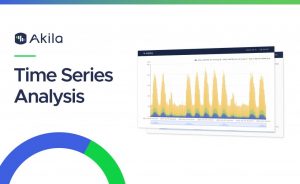
If you follow Akila and the digital twin industry, you already know the term “smart building.” What is the underpinning data that makes a smart building smart and lets it perform more efficiently and sustainably than a traditional structure? Time series analysis data is some of the most important.

Smart building management is largely driven by BMS (Building Management System) data, allowing portfolio managers to formulate measured operation plans from wind speed, temperature, illumination intensity, valve position, and more. In the past decades, data has mostly been captured manually and intermittently. For example, the average temperature over a set period is often taken as one major reference for building energy efficiency management. There is, however, a flaw – the average temperature may stay within a fixed data section, concealing the data changes which would be meaningful for anomaly detection and operation forecast. To operate at optimum, consistent and highly granular BMS data is essential – the answer is to bring in “time” as a crucial data variable and realize time series analysis.

High granularity reveals valuable metrics

What is time series data? It is a consistent sequence of data points obtained through repeated measurements from the same source and placed in time order. Time series analysis transforms the traditional method of updating data into a real-time recorded data point so that it can visualize data changes and variations, create a basis for comparative analysis, and turn data into KPIs and indicators.

If we go back to the example of temperature data, but now with time series analysis, it is possible to visualize and compare temperature with other data (such as cloud cover, precipitation, and wind speed) tracked by the minute, which outlines a more detailed and complete picture of operational performance and increases optimization opportunities. Starting early this year, Akila supports sub-minute level time granularity in time series analyses. It is currently applied to a wide range of measurement scenarios on the Akila platform – operation, energy, HVAC, and indoor environment quality (IEQ) sensors.

Understanding the past, present and future

In the building management industry, time series analysis lifts the precision of fault detection and diagnostics (FDD) to a higher level than ever. On the Akila platform, analysts can integrate real-time data points from various equipment including (but not limited to)  sensors, controllers, coils, dampers, air handling units, and variable air volume systems. Integrated with AI and machine learning algorithms, time series data can be assessed through operation logic and translated into actionable information.

How does it work? When operational errors, manual overrides, or failed devices are leading to a failure or a loss of performance, the faults can be immediately reflected on the time series charts, such as a certain length of noise in the data, abnormal benchmarking, or deviation from baseline. For users of Akila, instant FDD alarms will be sent to them based on time series analysis, and Akila will continue tracking the resolution of the alarms through time series analysis and work orders to make sure the completion of FDD management.

Time series analysis example

Additionally, time series data can be leveraged for performance prediction based on historical data and real-time weather data, setting guidelines for predictive and preventive measures. For example, energy and HVAC optimization are highly correlated with the seasons. A customized view can be created using Akila to compare the energy consumption to the set baseline to visualize the performance and predict the savings. If the prediction tells negative outcomes, portfolio managers can dive into possible factors, identify the problems (e.g. a valve is leaking or stuck, a new air filter is needed), and optimize.

Akila brings you more

Time series analysis is powerful but demands quality infrastructure to unleash its capability. The first and most important prerequisite to realizing time series analysis is to collect clean data, otherwise, valuable data will be buried in noisy raw data. Deploying sophisticated and expensive sensors would be the ultimate solution, but besides that, Akila can help in a software way – backed up by the profound partnership with Microsoft, Akila has built with Azure tools an advanced data extract, transform and load (ETL) process that can largely reduce the noise of sensor data and transfer clean data for analytics. Another prerequisite is the safe storage of time series data. Historically, sensor data points would be stored only for a limited time and are easily lost. Built on the cloud, Akila manages a tremendous volume of data, making long-term time-based analysis feasible.

Designed as a single source of truth data platform, Akila integrates a wide scope of inputs, covering the whole lifecycle of a building, including indoor, energy, and operational data types. It extends the potential of comparative analysis and modeling and helps reveal the truth by sourcing every single piece of evidence. And it creates the perfect environment for streamlining and optimizing ESG reporting. Akila’s ESG analytics are investment-grade as it enables real-time identification of ESG risks. Compared to those relying on traditional ESG platforms that need to wait until the end of the year to evaluate their ESG targets. Akila provides its users the chance to detect ESG performance problems and fix them before too late.

Related Articles
Akila becomes a member of the Digital Twin Consortium

Akila becomes a member of the Digital Twin Consortium

Akila appoints CTO to accelerate ESG-driven innovation for the built environment

Akila appoints CTO to accelerate ESG-driven innovation for the built environment

Arkema China Changshu R&D center selects Akila digital twin platform as partner in its decarbonization strategy

Arkema China Changshu R&D center selects Akila digital twin platform as partner in its decarbonization strategy

Take the next step with Akila

If you want better from your buildings, our team is here to help. Let’s set up a call to discuss your needs and show you how Akila works, from deploying digital infrastructure to optimization.

910-Product-page
Secondary ~ Request Demo Simple