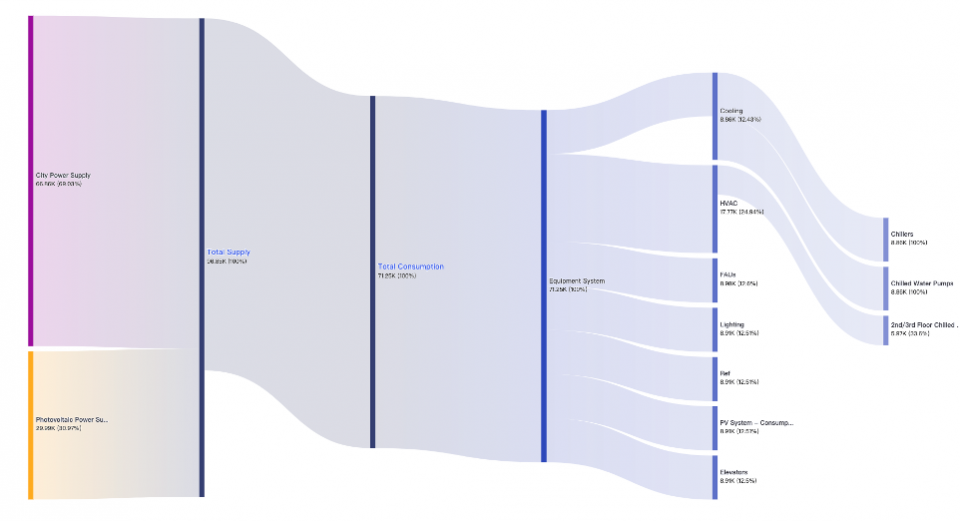
Understanding how energy moves through a building has always been one of the biggest challenges in facility and sustainability management. Data comes from everywhere including utility feeds, renewable systems, sub-meters, sensors, and BMS points,but it rarely comes together in a way that reveals the full picture. Most systems can tell you how much energy a building uses. Very few can show you where that energy comes from, how it’s distributed, and what (or who) is driving the demand.

Akila’s improved Energy Flow Analysis feature is built to change that. By turning fragmented, complex data into a complete, intuitive, and shareable map of energy from supply to final consumption, it gives organizations the clarity they need to understand performance, improve coordination, and take faster, data-backed action.


The problem: Energy data without structure creates blindspots

Modern buildings generate enormous volumes of information. Yet the systems designed to interpret that information often struggle with transparency.

  • Energy supply is split across grid feeds, renewables like PV systems, and sometimes backup generators or batteries.
  • Consumption is scattered across tenants, equipment categories, operating schedules, and zones.
  • Different teams create their own diagrams or spreadsheets, leading to inconsistencies and duplicated work.
  • Portfolio managers struggle to benchmark sites because each building reports energy differently.
  • Facility teams are left reacting to peaks and inefficiencies rather than preventing them.

Without a structured and intuitive way to visualize the entire energy chain, even the best teams are making decisions in the dark.


Introducing Akila’s enhanced Energy Flow Analysis

Akila’s Energy Flow Analysis creates a complete end-to-end map of where your building’s energy comes from and where it goes. Built on top of a detailed digital twin, the feature transforms raw datapoints into a cohesive energy story.

What sets Akila apart is its powerful, flexible IoT integration framework. Akila seamlessly connects to a wide variety of data sources including electricity meters, water meters, smart sockets, environmental sensors, and legacy BMS points across multiple protocols (MQTT, HTTP API, FTP, and more). This adaptability is the result of years of integrating with both local and global IoT suppliers, as well as third-party and legacy systems.

Whether your building uses locally sourced hardware or a unified global supplier, Akila’s platform ensures that every relevant datapoint is captured, structured, and made available for analysis. Our reusable integration scripts and standardized data models guarantee that energy flow insights are consistent, scalable, and reliable across diverse building portfolios and regions.

With this feature, users can:

  • Visualize the full supply-to-consumption energy journey.
  • See relationships between energy sources, equipment groups, zones, and tenants.
  • Compare real-world flows against expected patterns.
  • Spot anomalies, inefficiencies, and underperforming assets instantly.
  • Align cross-functional teams around one shared view of building performance.

Rather than jumping between multiple sources of truth, teams get a unified energy picture that is accurate, real-time, and actionable.


How it works

Akila begins by integrating data from every relevant source: grid import meters, onsite renewable systems like PV arrays and batteries, tenant sub-meters, equipment-level sensors, and BMS points. This raw data is then cleaned, time-aligned, and mapped into the building’s digital twin, creating a consistent, structured foundation for analysis.

Once the data is organized, Akila generates a dynamic supply-to-load energy flow diagram that visually traces how energy moves through the building – from input sources all the way to consumption by equipment and zones. This intuitive visualization makes it easy to see dependencies, identify bottlenecks, and understand the true story behind energy use.

Finally, these insights are actionable. They inform and enable predictive maintenance, optimization strategies, and reporting workflows, allowing teams to react quickly or even automate responses through Akila’s control features. The result is a unified, real-time understanding of building energy that supports smarter decisions at every level.


Three ways users gain immediate value

  1. Supply side intelligence – Understanding where energy comes from

For buildings using a mix of grid electricity, PV generation, and battery storage, understanding energy supply is critical.

Akila breaks down exactly how much energy is coming from each source and how those sources are being used.

This enables users to:

  • Measure real renewable self-consumption rates.
  • Identify when PV underperforms and diagnose why.
  • Shift loads away from expensive grid periods.
  • Optimize the building’s cost and emissions strategy.

The result is a clearer understanding of your energy mix and more confident decisions around purchasing, scheduling, and sustainability.


  1. Tenant breakdowns – Transparent and fair energy attribution

For multi-tenant buildings, energy transparency is often a pain point. Manual sub-meter reads, inconsistent billing logic, and disputes can eat resources and erode trust.

Akila solves this by breaking down energy consumption by tenant, with data mapped directly to the 3D digital twin.

This gives property managers and owners the ability to:

  • Accurately attribute consumption for billing or reporting.
  • Identify tenants with unusually high load intensity.
  • Highlight savings opportunities specific to each tenant.
  • Reduce disputes through clear, verifiable consumption records.

Improved transparency strengthens landlord-tenant relationships and supports better long-term planning.


  1. Equipment System breakdown – Benchmarking what drives demand

Not all systems contribute equally to a building’s energy load. HVAC may dominate in one building, while pumps or industrial equipment dominate in another.

Akila visualizes consumption by equipment category so users can understand which systems are responsible for which portion of total demand.

This helps teams:

  • Benchmark equipment performance against design values or peer buildings.
  • Spot equipment types with recurring inefficiencies.
  • Prioritize maintenance, upgrades, or operational tuning where it matters most.
  • Detect early signs of equipment degradation through rising energy intensity.

Instead of looking at building-wide totals, operators get detailed clarity on what’s driving energy use.


Why this matters for the future of smart buildings

Energy Flow Analysis closes one of the biggest gaps in building management: the lack of a unified, intuitive, and actionable understanding of how energy moves through the built environment.

With this feature, teams can:

  • Shift from reactive firefighting to predictive planning.
  • Align sustainability and operations teams around shared, trusted data.
  • Build more accurate forecasts and budgets.
  • Support audits, compliance, and ESG reporting with confidence.
  • Unlock new optimization pathways powered by AI and automation.

As buildings grow more complex and energy costs rise, this level of clarity is no longer a nice-to-have — it’s essential.


Related Articles
Feature focus: Akila Energy Savings Tracker

Feature focus: Akila Energy Savings Tracker

Leveraging real-time data and digital twins to drive sustainability

Leveraging real-time data and digital twins to drive sustainability

Managing the electricity impact of EV charging on buildings

Managing the electricity impact of EV charging on buildings

Take the next step with Akila

If you want better from your buildings, our team is here to help. Let’s set up a call to discuss your needs and show you how Akila works, from deploying digital infrastructure to optimization.

910-Product-page
Secondary ~ Request Demo Simple

Akila and Ubicité (Altitude Group) announce a strategic alliance to accelerate the digital and sustainable modernization of public buildings in France

December 01, 2025

Paris — At the Salon des Maires et des Collectivités Locales, Akila, a digital-twin and artificial-intelligence platform dedicated to building performance, and Ubicité, a national operator of territorial digital solutions and a subsidiary of Altitude Group, announced a strategic alliance designed to accelerate the sustainable, long-term modernization of public buildings at scale.


Ubicité: territorial expertise serving public-sector performance

Ubicité designs, integrates and operates long-term, sovereign data-collection networks that support local authorities strengthen public-sector performance.

As a subsidiary of Altitude Group, France’s third-largest telecom-infrastructure operator, Ubicité draws on more than twenty years nationwide deployment of open and sovereign networks. This experience positions Ubicité as a trusted partner engaged in ambitious modernization strategies.

Ubicité operates across the entire value chain:

  • IoT and LoRaWAN networks
  • Installation and operation of sensors
  • Energy and environmental monitoring
  • Public-building management
  • Territorial operations and field support

With UbiOne, its new 360° territorial monitoring and data-visualization platform, Ubicité provides local authorities with a unified, sovereign environment for visualizing assets, analyzing usage patterns monitoring performance indicators and supporting strategic decision-making


Merging territorial infrastructure and building intelligence

Under the partnership, Akila integrates its operational digital twin and unified data model with Ubicité’s territorial IoT ecosystem, creating a seamless digital continuum from real-time sensing through to strategic decision-making.

This collaboration builds on an initial deployment in Côte-d’Or, where Ubicité delivered a sovereign architecture for IoT and public-building data. Akila will now extend this foundation by activating its NVIDIA-powered AI agents to optimize energy performance, maintenance operations, comfort and investment planning.

“Ubicité relies on the national presence of Altitude Group to deliver reliable and sovereign digital services to local authorities. Our alliance with Akila creates a new form of digital continuity between territorial infrastructure and building optimization. It offers a concrete, operational response to the performance and sustainability challenges facing public assets.”

Guillaume Rochette, Managing Director, Ubicité


A sovereign model for France and Europe

Akila provides a digital-twin and AI platform deployed across several million m² worldwide. Built on a semantic data model, OpenUSD integration, and a unified reference of assets, the solution turns fragmented data into actionable operational intelligence.

Its AI agents — powered by NVIDIA technologies — automatically optimise HVAC, energy consumption, maintenance, work planning and carbon performance.

“Ubicité’s territorial presence and the strength of Altitude Group make it the ideal partner to deploy the Akila digital twin at scale in France and Europe.” says Pierre-Manuel Patry, EMEA Director at Akila. “Together, we are building a fully sovereign end-to-end modelfrom the sensor layer to investment committees, delivering immediate and measurable results.”


An ambitious and replicable roadmap

The partnership includes:

  • Extending the deployment in Côte-d’Or to other additional public buildings.
  • Ensuring complementarity between UbiOne’s territorial monitoring platform and the Akila digital twin (building optimisation).
  • Integrating Akila’s NVIDIA-based AI agents.
  • Developing replicable models for municipalities, departments, metropolitan areas and regions.
  • Building a 100% sovereign digital chain in cooperation with other French and European actors.

Together, Akila and Ubicité aim to provide local authorities with concrete, sovereign and AI-enabled solutions to enhance building performance, reduce carbon emissions, and modernize real-estate portfolios at scale.

Related Articles
Akila Expands R&D Hub in Vietnam to Drive AI-Powered Cognitive Buildings

Akila Expands R&D Hub in Vietnam to Drive AI-Powered Cognitive Buildings

Get ENERGY STAR certification for your building

Get ENERGY STAR certification for your building

HVAC efficiency in a time of energy shortages and insecurity

HVAC efficiency in a time of energy shortages and insecurity

Take the next step with Akila

If you want better from your buildings, our team is here to help. Let’s set up a call to discuss your needs and show you how Akila works, from deploying digital infrastructure to optimization.

910-Product-page
Secondary ~ Request Demo Simple

Akila and UM6P Build First Campus-Scale Digital Twin Using NVIDIA Omniverse and NVIDIA Metropolis

November 05, 2025


Ben Guerir, Morocco — November 5, 2025 — Akila has launched a campus-scale digital twin for Mohammed VI Polytechnic University (UM6P), establishing an AI infrastructure that spans 50 buildings across a 55-hectare site, home to more than 7,000 students. Built leveraging NVIDIA Blueprint for smart city AI, a reference architecture to build, train, and deploy city-scale AI. The project maps to the blueprint workflow showcasing a new benchmark for how simulation, real-time intelligence and semantic data can be fused at scale to enable smarter, more responsive environments.


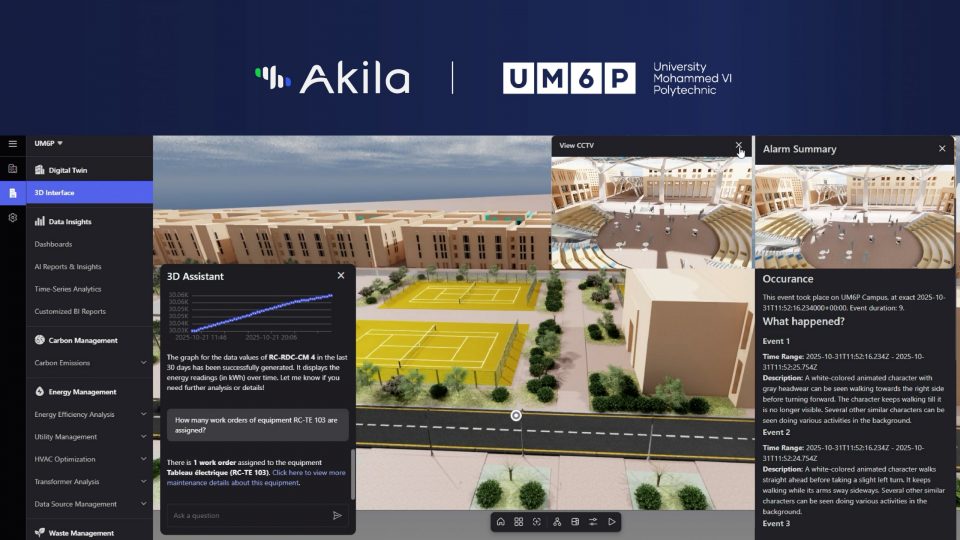
This is the first time Akila’s full platform has been deployed at campus scale, transforming UM6P into a living laboratory for future smart-city systems. A deep technical integration was needed to make the solution possible including NVIDIA Omniverse libraries for synthetic data generation, vision AI ingestion from real-world sensors with NVIDIA Metropolis, the NVIDIA AI Blueprint for Video Search and Summarization (VSS) and NVIDIA Cosmos Reason to deploy video analytics AI agents for ongoing alerts and efficient operations.


The digital twin integrates diverse data sources — from building systems to utilities and mobility flows — within a structured, continuously updated Omniverse environment. It also introduces new layers of mobility and vehicle data, intelligently linked to the 3D model and natural language interfaces, giving campus operators unprecedented operational insight.


A distinctive capability of the platform is its use of a custom video language models (VLMs) trained with NVIDIA Cosmos Reason, enabling a contextually aware AI agent to deliver real-time video intelligence across the entire campus. Combined with Akila’s semantic graph, these models can analyze crowd movement, traffic flows and incident patterns, then feed the results back into simulations to support predictive and operational decision-making.


Stakeholders can also query the twin through LLM-powered interfaces, asking complex questions in natural language and receiving contextualized answers and automated reports. Whether it’s occupancy trends, mobility anomalies or energy deviations, campus managers can get precise, actionable intelligence on demand.


“What we’re building at UM6P is the AI infrastructure of the future — one that connects simulation, real-time intelligence and semantic data to create something far more powerful than the sum of its parts,” said Philippe Obry, Vice-President of Akila. “NVIDIA Blueprint for smart city AI and the incorporated technologies have accelerated our ability to integrate these layers at campus scale, turning the digital twin into a living, intelligent system.”


“With UM6P, we’re creating a uniquely data-rich and queryable digital environment,” said Pierre-Manuel Patry, Head of EMEA at Akila. “Any stakeholder can retrieve detailed, AI-generated insights about their area of focus, or generate automated reporting on demand. It’s a degree of control made possible by Akila’s unified AI infrastructure — and a perfect showcase of what a smart campus can be.”


By linking simulation, video intelligence, semantic structuring and natural language interfaces, Akila and UM6P are demonstrating how NVIDIA technologies can be operationalized to build next-generation AI infrastructure for the built environment — scalable from a single campus to entire smart cities.


Akila will be presenting this deployment live at the Smart City Expo World Congress 2025 in Barcelona from November 4-6, 2025. Akila can be found at the Mindware booth, and encourages all visitors to join us for a preview of our work in campus-scale digital twin.

Related Articles
Event Recap — “Climate Countdown”: ESG & Decarbonization in Healthcare

Event Recap — “Climate Countdown”: ESG & Decarbonization in Healthcare

Akila x Milesight: Accelerating the AIoT Frontier for Smarter, Safer, Greener Spaces

Akila x Milesight: Accelerating the AIoT Frontier for Smarter, Safer, Greener Spaces

Building Smarter, Greener Futures: Akila at IGBC 2025 

Building Smarter, Greener Futures: Akila at IGBC 2025 

Take the next step with Akila

If you want better from your buildings, our team is here to help. Let’s set up a call to discuss your needs and show you how Akila works, from deploying digital infrastructure to optimization.

910-Product-page
Secondary ~ Request Demo Simple

Unlocking HVAC Efficiency: How Smart Control Transforms Building Operations

September 17, 2025
Related Articles
Asset SUITE: empowering technical teams, extending asset lifespans

Asset SUITE: empowering technical teams, extending asset lifespans

Akila’s Transition Plan : “Race to Zero”

Akila’s Transition Plan : “Race to Zero”

Akila Featured in Jensen Huang’s NVIDIA Keynote at GTC Paris 2025

Akila Featured in Jensen Huang’s NVIDIA Keynote at GTC Paris 2025

Take the next step with Akila

If you want better from your buildings, our team is here to help. Let’s set up a call to discuss your needs and show you how Akila works, from deploying digital infrastructure to optimization.

910-Product-page
Secondary ~ Request Demo Simple