Building the next generation of smart campuses: Energy, operations, and video intelligence in education

December 11, 2025


Educational institutions today face a unique combination of operational pressures. Campuses are growing more complex to manage, students and faculty expect safer and more responsive environments, and administrators are under increasing pressure to reduce energy consumption and meet sustainability targets. As these needs expand, campuses must look for tools that provide better visibility, faster decision making, and long-term resiliency.

Akila supports this transformation by bringing campus operations, energy management, maintenance, and video intelligence together into a single, unified platform. For schools, universities, and research facilities, this creates a clearer, more actionable understanding of how their campuses are performing in real time.


Modern challenges across campus operations

Most educational environments face a similar set of hurdles. Large campuses often rely on aging or inconsistent infrastructure, with HVAC, utilities, and equipment spread across many different building types. Energy consumption is high, especially in spaces such as labs, dormitories, and lecture halls. Maintenance teams struggle with limited visibility and reactive workflows. On top of this, institutions need faster ways to understand what’s happening across campus – whether an incident needs review, a crowded area needs attention, or a room’s usage patterns suggest a better scheduling or energy strategy.

These challenges create inefficiencies that impact sustainability, campus experience, operational continuity, and planning.


A unified digital foundation for smarter campuses

Akila addresses these challenges through a holistic approach that connects building systems, equipment data, IoT devices, and video sources into a single platform. This gives administrators, facility teams, and safety staff a shared operational picture of the entire campus.

Optimized energy and HVAC performance

AI-driven analytics help institutions better understand how their buildings consume energy, alert teams to anomalies, and automatically adjust HVAC systems according to occupancy and usage patterns. Whether for classrooms, research spaces, or residential buildings, Akila delivers more efficient performance while still maintaining comfort and reliability. Clear energy baselining and carbon tracking also help institutions align to sustainability commitments and regulatory requirements.

Predictive maintenance and digital twin visualization

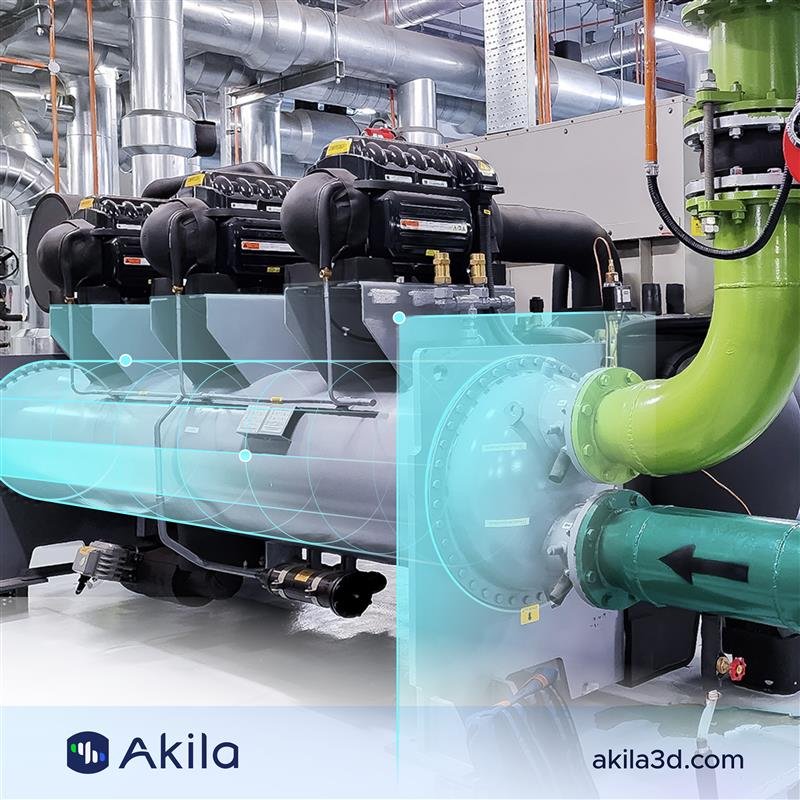
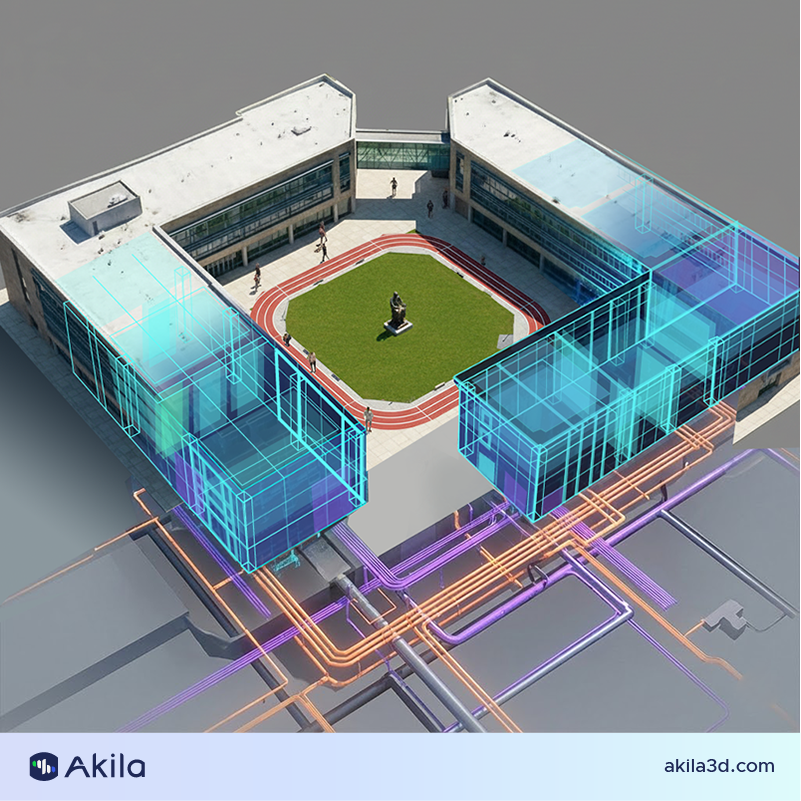
A campus-scale digital twin brings every asset and building into a clear 3D view, allowing teams to quickly locate equipment, understand system relationships, and respond faster. Condition-based maintenance ensures that faults are detected early and repairs are scheduled before they disrupt classes or operations. As campuses expand, this digital foundation becomes a critical tool for planning and long-term lifecycle management.

Video analytics for faster insights

As campus environments grow more dynamic, the ability to quickly understand what happened in a specific area or timeframe becomes increasingly important.

Akila integrates Video Search and Summarization (VSS) to make video data more accessible and efficient to use. Instead of manually reviewing long footage, teams can use AI to instantly search for relevant moments or generate concise summaries around an event window or location. This supports faster incident verification, better coordination, and a clearer understanding of activity patterns across the campus.

VSS is not positioned as surveillance technology – it is an operational intelligence tool that helps education institutions gain insights quickly, improve response times, and make more informed decisions about space utilization and campus planning.


Creating better learning environments

When energy management, maintenance, and video intelligence operate through a unified platform, campuses experience tangible improvements.

  • Learning spaces stay more comfortable and consistent.
  • Maintenance issues are addressed proactively rather than reactively.
  • Activity patterns reveal how buildings are truly used, supporting smarter scheduling and resource allocation.
  • Campus teams gain faster access to critical information during incidents or peak activity periods.
  • Sustainability strategies align more closely with real operational data.

These outcomes directly support the core mission of education institutions: providing safe, healthy, and empowering environments for students and staff.


Designed to scale across diverse campus environments

Akila is designed to scale seamlessly from single buildings to multi-campus portfolios. Institutions can standardize energy reporting, maintenance workflows, and operational practices across all locations while maintaining the flexibility needed for different building types and usage patterns.

This approach provides administrators with long-term digital governance and ensures consistency even as campuses expand, renovate, or adapt to new operational demands.


Building the future of digital education infrastructure

The future of campus operations will rely on integrated digital systems that combine energy intelligence, predictive maintenance, real-time visualization, and rapid video-based insights. By bringing these capabilities together, Akila helps educational institutions move toward safer, more efficient, and more sustainable campuses — all while empowering teams to make better decisions every day.

Related Articles
2024 – Akila’s Global Recap

2024 – Akila’s Global Recap

HVAC efficiency in a time of energy shortages and insecurity

HVAC efficiency in a time of energy shortages and insecurity

Monthly recap : October

Monthly recap : October

Take the next step with Akila

If you want better from your buildings, our team is here to help. Let’s set up a call to discuss your needs and show you how Akila works, from deploying digital infrastructure to optimization.

910-Product-page
Secondary ~ Request Demo Simple

Event Recap — “Climate Countdown”: ESG & Decarbonization in Healthcare

November 03, 2025
Related Articles
Smarter Lighting, Smarter Buildings: Unlocking Hidden Energy Savings 

Smarter Lighting, Smarter Buildings: Unlocking Hidden Energy Savings 

The role of Building Management Systems in improving occupants’ safety

The role of Building Management Systems in improving occupants’ safety

How digital twins and AI can enhance accessibility through asset management

How digital twins and AI can enhance accessibility through asset management

Take the next step with Akila

If you want better from your buildings, our team is here to help. Let’s set up a call to discuss your needs and show you how Akila works, from deploying digital infrastructure to optimization.

910-Product-page
Secondary ~ Request Demo Simple

What happened with digital twins, decarbonization and ESG in 2022 (and where we are headed 2023)

January 10, 2023

Sustainable ESG building 2023

2022 was an incredibly eventful year for digital twins, ESG, and decarbonization. It was also an incredible year for Akila – starting off with a bang by being chosen as a World Economic Forum Technology Pioneer. Around the rest of the world, there were non-stop developments that will shape how businesses, investors, and consumers approach them over the next year. In some areas, there were some slight setbacks, but generally, the trends were positive.

One trend that we are seeing emerge is that these three topics are becoming less and less distant from each other as the market becomes more educated. That is to say that business stakeholders and regulators are looking at things like transparency, data security, carbon emissions, employee and occupant wellbeing, and community impact more holistically. Digital twins and digitalization platforms were at the center of this discussion – since there is virtually no other way to accurately collect and centralize the data from all these sectors without it.

Although this trend is starting to become more visible, there is still a long way to go to realizing a global business ecosystem capable of reaching net-zero carbon and the 1.5°C target. However, there have been several important developments that show that it is headed in the right direction.

Global commitments to carbon reduction and climate action

COP27

At the 27th Conference of the Parties (COP) in November 2022, 193 representing parties from around the world met to accelerate the implementation of climate plans and the goals of the United Nations Framework Convention on Climate Change (UNFCCC).

The findings from the Emissions Gap Report 2022 prior to the meeting were not optimistic, finding that the progress towards meeting the 1.5°C goal from the Paris Agreement was not on track. The meeting also did not result in any concrete action plans or commitments for the coming years, although there was agreement on how this action plan might start to take shape: accelerating the deployment of “transformative” technologies and the rollout of more green financing.

How Akila is helping businesses decarbonize in 2023

In 2022, Akila was proud to join the Business Ambition for 1.5°C and support emissions reductions in line with the Science Based Targets Initiatives Net-Zero Standard as well as the UNFCCC’s “Race to Zero” campaign. These commitments are essential to our mission to help businesses decarbonize through digitalization.

The construction and operation of buildings together account for 40% of global greenhouse gas (GHG) emissions, with most of that coming from operations! The Akila platform gives businesses and building managers a path toward carbon reduction by optimizing the lifetime operating efficiency of greenfield and brownfield sites. By reducing the carbon footprint of our client’s buildings and facilities, we are contributing to the fight to keep global warming at 1.5°C above pre-industrial levels.

ESG: corporate action and investor reactions

Technology is the answer to meeting ESG requirements

A 2022 Deloitte survey of publicly traded companies uncovered some very important data regarding how businesses are responding to the need to track, report, and improve on ESG metrics. Almost every surveyed firm – 99% of respondents – is somewhat or very likely to invest more in ESG-focused technology over the course of 2023. Furthermore, many companies (62%) are taking proactive measures to prepare for increases in requirements from rating agencies. A majority also report leveraging multiple standards or frameworks for disclosures.

Misalignment and misunderstandings of ESG standards

The lack of unification in reporting standards is a recurring theme this year in the realm of ESG. In what has been called “aggregate confusion,” business stakeholders and investors are unhappy with the amount of divergence between the varying different rating standards in terms of measurement, scope, and weight. Furthermore, many investors are unsatisfied with rating standards that they believe are too narrow.

It’s not just investors that are scrutinizing these ratings. In response to a massive rise in sustainable investments ($2.7trn in more than 2,900 ESG funds), regulators such as the SEC are putting their eye on the growing amount of ESG funds to root out “greenwashing.” Many of these funds are being investigated to ensure that the underlying investments follow proper policies to be labeled “sustainable.” In fact, Goldman Sachs Asset Management was fined $4 million for failing to do so this November.

At the same time, there are also signs that many investors do not fully trust ESG metrics as a solid stand-in for risk aversion, as investors pulled more money out of funds labeled sustainable than they have in a decade due to ongoing global political and economic crises.

Although there have been some setbacks in the world of ESG – driven partially by a lack of understanding and partially by global events – the numbers show that investors are still more serious about ESG than ever with 62% (a 4% increase from 2021) of investors and service providers integrate ESG principles into their portfolio strategy according to a Pitchbook survey.

How Akila is making ESG goals more attainable in 2023

A key feature of the Akila platform has always been dashboards for monitoring and tracking ESG performance metrics – especially as it relates to emissions. Last year we improved this feature by developing carbon accounting features inside the Akila platform to track scope 1 & 2 emissions. In 2023, we are working on expanding this to account for scope 3 emissions as well.

Our ESG experts work hard to help clients cut through the noise to focus on measuring the most accurate and relevant information possible, and by integrating data collection relevant to a range of ratings and standards to meet the need to centralize diverse data sets.

ESG analytics dashboard

Akila’s ESG Analytics dashboard


Request a demo


Akila’s mission is to improve ESG performance and reduce ESG risks for our clients, which fits with our larger vision of aligning sustainability with profitability. Our efforts to do so last year earned us the Solar Impulse efficient solutions label. The organization recognized Akila’s potential to meet one of its core missions of aligning profitability and sustainability by optimizing operational efficiency and Total Cost of Ownership (TCO) of buildings and assets.

Digital twins, data and cybersecurity

Exploding interest in cybersecurity & digital twins

2022 saw rising attention on both digital twins and cybersecurity. According to a survey by the Capgemini Research Institute (CRI), 69% of the more than a thousand organizations plan major overhauls to their cybersecurity. Over 80% of those organizations have ongoing digital twin programs and the remaining 20% are planning to implement one. Furthermore, more than half (55%) consider digital twin as critical to their digital transformation.

This survey is backed up by market growth as well. As of this year, the digital twin market is valued somewhere around $8 billion (or more according to some research firms such as IMARC Group and Mordor Intelligence) and is expected to continue to grow at a CAGR of 30-40% or higher through the end of the decade. The same goes for cyber security with a CAGR of 10%+.

Cybersecurity & ESG

With a rise in ransomware attacks in recent years, cyber security is being looked at more as a core pillar of risk mitigation. Breaches in cyber security erode the trust of all stakeholders in an organization, from investors to employees to customers. The damage caused by cybersecurity incidents touches on every pillar of ESG. In fact, according to RBC Global Asset Management Responsible Investment Survey, asset managers rank cyber security as their second biggest concern among ESG-related themes.

Although cyber security is not officially its own pillar in ESG, it is starting to converge more with the other established three. Governmental organizations like the European Union and SEC are already pushing for more aggressive cybersecurity regulations and transparency. Organizations are already responding as well, implementing measures such as Zero-Trust, Cybersecurity Mesh, and bolstering digital supply chains.

How Akila is at the forefront of digital twins and cybersecurity in 2023

Last year, Akila deployed major projects for clients such as Ikea, Saint Gobain, Arkema, and Bollore. All these clients see digital twin technology as a core element in their digital transformation strategies, with operational efficiency, carbon reduction, and an optimized TCO as the most direct benefits of their adoption. Each of these organizations also sees the value in the wealth of data that can be uncovered with a digital twin, which can help with transparency to assist with decision-making and compliance – especially when it comes to ESG reporting. Likewise, collaborating with these firms will accelerate the advancement and development of the Akila platform to be the best digital twin platform for our clients.

Cyber security is also a top concern for our clients. It’s also a cornerstone of our project deployment and operation. That is why Akila uses Microsoft Azure to collect, process, and store data. Azure uses highly certified cybersecurity practices, with features for users such as Defender for Cloud, as well as a $1 billion USD per year budget on cybersecurity and physical security. Akila also relies on our own cybersecurity experts to design IoT architecture solutions for our clients, including local Edge networks that operate in isolation from the internet.

Are you ready for 2023?

With the start of the year comes the rush to finalize business plans, budgets, and objectives. Many organizations will be thinking about how to take steps to start improving the way their facilities operate, especially regarding sustainability, ESG performance, digital transformations, and cyber security. It can be a daunting challenge for businesses at any stage of digitalization or any level of sustainability to make a plan that can also deliver an ROI. But it can be a lot easier with Akila.

Related Articles
Scope 3 emissions: challenges and solutions

Scope 3 emissions: challenges and solutions

Smarter Manufacturing Starts with Unified Data 

Smarter Manufacturing Starts with Unified Data 

Managing the electricity impact of EV charging on buildings

Managing the electricity impact of EV charging on buildings

Take the next step with Akila

If you want better from your buildings, our team is here to help. Let’s set up a call to discuss your needs and show you how Akila works, from deploying digital infrastructure to optimization.

910-Product-page
Secondary ~ Request Demo Simple

Feature focus: ESG Dashboard

May 25, 2022
Akila ESG Dashboard

Key benefits:

  • Capability for international and customized ESG management
  • Reports with Global Reporting Initiative standard KPI Options for multiple frameworks
  • Real-time analytics of ESG-related risks and trends

A sustainability cockpit for decision-makers and portfolio managers

There is no doubt that the ESG era is in full swing. However, as multinationals and portfolio-holders around the world rush to adopt ESG frameworks, many are encountering considerable practical challenges in achieving the systemic measurement of sustainability required by ESG, and achieving fast, responsive monitoring of the performance of their sites in critical areas like carbon and waste. This is precisely why Akila’s ESG dashboard was created, providing portfolio managers with a “sustainability cockpit” that allows global-level views of portfolio performance, real-time and actionable information about problems at their site, and the ability to zoom into detail on any asset in their portfolio down to the level of individual pieces of equipment.

Streamlined emissions calculations, viewed from anywhere

Global portfolio holders have to draw data on energy use and emissions from multiple sites, accurately and reliably. For example, a portfolio may include an office in Guangdong with on-site solar and a factory in Indonesia using coal-based power from the grid, meaning each will have a different CO2 equivalent emission from their energy use. Akila intelligently accounts for the local energy mix at each site and calculates CO2 emissions and energy usage based on local conditions and continuous sensor data, fed securely to the cloud using Azure IoT Edge and Hub.

Streamlining CO2-equivalent emissions and aligning them requires global infrastructure to be made usable—in March, Akila launched its Hong Kong-based ASEAN data center providing fast, secure and reliable access to Akila in full compliance with the data protection policies in both mainland China and Southeast Asian countries. All this adds up to a secure, globally accessible platform with real-time ESG data.

Transform annual reporting into action with ESG Analytics

Global portfolio holders are obliged to perform ESG reporting annually—but management is a daily and continuous process. Simply having the data isn’t as much of a problem as having it at the right time. The ESG Dashboard’s analytics empower users to tackle complex tasks and ambitious goals with proactive management.

For example, a site manager may have to reduce energy intensity and waste generation by 10% in a single year across a wide-ranging portfolio. This is no small task. Say a factory in Malaysia has failed to meet its energy efficiency goals. Energy intensity is too high—the problem can’t be the whole factory obviously. Digging deeper, the site’s assets can be examined in detail. Chillers, boilers, HVAC, compressors. Looking closely, a compressor leak has been causing an energy drain. By scheduling a work order from within the Asset module, the problem can be solved immediately.

The problem of waste management hasn’t been solved yet though. Powered by the Environment Module, ratios of solid waste recycling, carting, and incineration are all visible in the ESG Dashboard. Types and categories of waste are visible, showing recycling opportunities. Chemical byproducts from production processes—are they being disposed of when they could be turned into a useful product? Could they be resold as a precursor to another concern? Are they being disposed of in environmentally positive ways? Handling these metrics from inside the dashboard will help reduce waste generation and promote the circular economy.

Adaptive and customizable for meeting any framework

Global portfolios are always a complex management task. In the ESG era, wide-ranging concerns require focused, nuanced, and customizable solutions. If you have sites in mainland China and ASEAN and are listed on the Hang Seng Index and Korea Exchange, reporting becomes a complex task. The Akila ESG Dashboard offers a powerful solution—customizable, multi-dashboarding for sites.

Investors may be most interested in the climate sustainability of a particular site in Korea—with this in mind, the TCFD may be the most appropriate framework for reporting. Or perhaps a future listing in New York is the goal—in which case the SASB might be an appropriate framework instead of the GRI framework. ESG reporting frameworks serve different goals and have different priorities. In any case, Akila’s ESG Dashboard is customizable and can provide the appropriate KPIs in the relevant framework for use.

A roadmap for getting better and better

The digital transformation in business is driven by data—and maintaining a chain of verifiable, high-quality data is essential for business growth. Many businesses struggle to break down data silos and create actionable operational data and metrics. Without first overcoming these silos and creating a platform for acting on this data, businesses are left in the dark until it comes time to tabulate ESG data and report. Akila solves these problems and puts businesses on a road to data actionability and full ESG accountability.

Related Articles
La French Tech: Tech for Good, Tech for Impact

La French Tech: Tech for Good, Tech for Impact

Akila Mobile is now available on iOS and Android

Akila Mobile is now available on iOS and Android

Akila partners with STACS ESGpedia to facilitate green financing

Akila partners with STACS ESGpedia to facilitate green financing

Take the next step with Akila

If you want better from your buildings, our team is here to help. Let’s set up a call to discuss your needs and show you how Akila works, from deploying digital infrastructure to optimization.

910-Product-page
Secondary ~ Request Demo Simple