Understanding how energy moves through a building has always been one of the biggest challenges in facility and sustainability management. Data comes from everywhere including utility feeds, renewable systems, sub-meters, sensors, and BMS points,but it rarely comes together in a way that reveals the full picture. Most systems can tell you how much energy a building uses. Very few can show you where that energy comes from, how it’s distributed, and what (or who) is driving the demand.

Akila’s improved Energy Flow Analysis feature is built to change that. By turning fragmented, complex data into a complete, intuitive, and shareable map of energy from supply to final consumption, it gives organizations the clarity they need to understand performance, improve coordination, and take faster, data-backed action.


The problem: Energy data without structure creates blindspots

Modern buildings generate enormous volumes of information. Yet the systems designed to interpret that information often struggle with transparency.

  • Energy supply is split across grid feeds, renewables like PV systems, and sometimes backup generators or batteries.
  • Consumption is scattered across tenants, equipment categories, operating schedules, and zones.
  • Different teams create their own diagrams or spreadsheets, leading to inconsistencies and duplicated work.
  • Portfolio managers struggle to benchmark sites because each building reports energy differently.
  • Facility teams are left reacting to peaks and inefficiencies rather than preventing them.

Without a structured and intuitive way to visualize the entire energy chain, even the best teams are making decisions in the dark.


Introducing Akila’s enhanced Energy Flow Analysis

Akila’s Energy Flow Analysis creates a complete end-to-end map of where your building’s energy comes from and where it goes. Built on top of a detailed digital twin, the feature transforms raw datapoints into a cohesive energy story.

What sets Akila apart is its powerful, flexible IoT integration framework. Akila seamlessly connects to a wide variety of data sources including electricity meters, water meters, smart sockets, environmental sensors, and legacy BMS points across multiple protocols (MQTT, HTTP API, FTP, and more). This adaptability is the result of years of integrating with both local and global IoT suppliers, as well as third-party and legacy systems.

Whether your building uses locally sourced hardware or a unified global supplier, Akila’s platform ensures that every relevant datapoint is captured, structured, and made available for analysis. Our reusable integration scripts and standardized data models guarantee that energy flow insights are consistent, scalable, and reliable across diverse building portfolios and regions.

With this feature, users can:

  • Visualize the full supply-to-consumption energy journey.
  • See relationships between energy sources, equipment groups, zones, and tenants.
  • Compare real-world flows against expected patterns.
  • Spot anomalies, inefficiencies, and underperforming assets instantly.
  • Align cross-functional teams around one shared view of building performance.

Rather than jumping between multiple sources of truth, teams get a unified energy picture that is accurate, real-time, and actionable.


How it works

Akila begins by integrating data from every relevant source: grid import meters, onsite renewable systems like PV arrays and batteries, tenant sub-meters, equipment-level sensors, and BMS points. This raw data is then cleaned, time-aligned, and mapped into the building’s digital twin, creating a consistent, structured foundation for analysis.

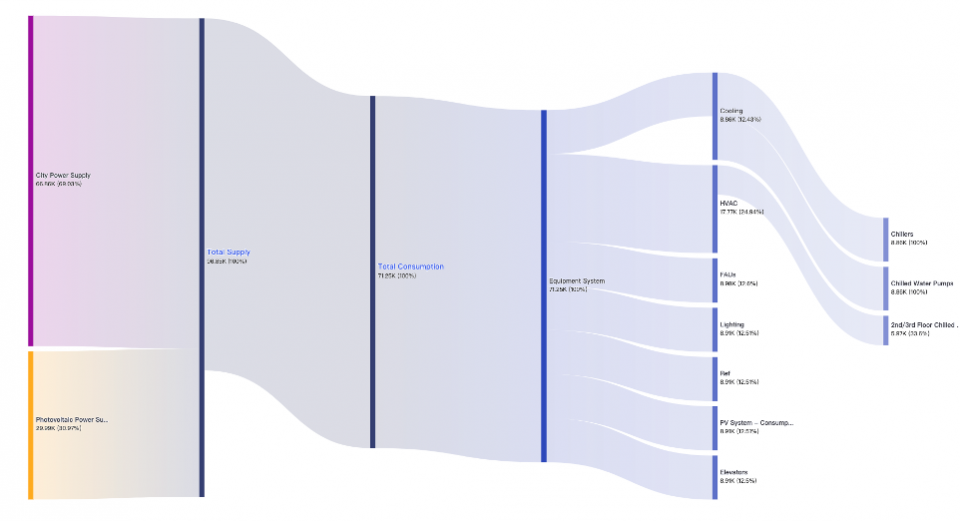
Once the data is organized, Akila generates a dynamic supply-to-load energy flow diagram that visually traces how energy moves through the building – from input sources all the way to consumption by equipment and zones. This intuitive visualization makes it easy to see dependencies, identify bottlenecks, and understand the true story behind energy use.

Finally, these insights are actionable. They inform and enable predictive maintenance, optimization strategies, and reporting workflows, allowing teams to react quickly or even automate responses through Akila’s control features. The result is a unified, real-time understanding of building energy that supports smarter decisions at every level.


Three ways users gain immediate value

  1. Supply side intelligence – Understanding where energy comes from

For buildings using a mix of grid electricity, PV generation, and battery storage, understanding energy supply is critical.

Akila breaks down exactly how much energy is coming from each source and how those sources are being used.

This enables users to:

  • Measure real renewable self-consumption rates.
  • Identify when PV underperforms and diagnose why.
  • Shift loads away from expensive grid periods.
  • Optimize the building’s cost and emissions strategy.

The result is a clearer understanding of your energy mix and more confident decisions around purchasing, scheduling, and sustainability.


  1. Tenant breakdowns – Transparent and fair energy attribution

For multi-tenant buildings, energy transparency is often a pain point. Manual sub-meter reads, inconsistent billing logic, and disputes can eat resources and erode trust.

Akila solves this by breaking down energy consumption by tenant, with data mapped directly to the 3D digital twin.

This gives property managers and owners the ability to:

  • Accurately attribute consumption for billing or reporting.
  • Identify tenants with unusually high load intensity.
  • Highlight savings opportunities specific to each tenant.
  • Reduce disputes through clear, verifiable consumption records.

Improved transparency strengthens landlord-tenant relationships and supports better long-term planning.
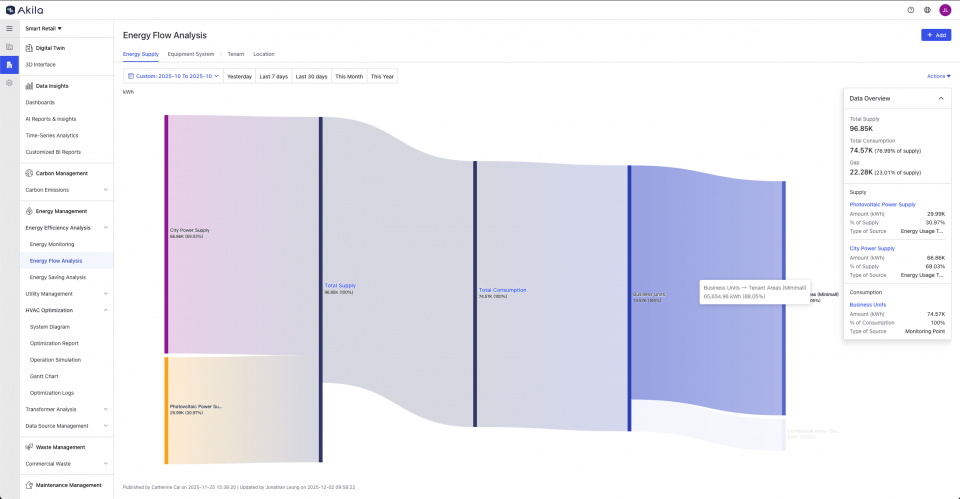


  1. Equipment System breakdown – Benchmarking what drives demand

Not all systems contribute equally to a building’s energy load. HVAC may dominate in one building, while pumps or industrial equipment dominate in another.

Akila visualizes consumption by equipment category so users can understand which systems are responsible for which portion of total demand.

This helps teams:

  • Benchmark equipment performance against design values or peer buildings.
  • Spot equipment types with recurring inefficiencies.
  • Prioritize maintenance, upgrades, or operational tuning where it matters most.
  • Detect early signs of equipment degradation through rising energy intensity.

Instead of looking at building-wide totals, operators get detailed clarity on what’s driving energy use.


Why this matters for the future of smart buildings

Energy Flow Analysis closes one of the biggest gaps in building management: the lack of a unified, intuitive, and actionable understanding of how energy moves through the built environment.

With this feature, teams can:

  • Shift from reactive firefighting to predictive planning.
  • Align sustainability and operations teams around shared, trusted data.
  • Build more accurate forecasts and budgets.
  • Support audits, compliance, and ESG reporting with confidence.
  • Unlock new optimization pathways powered by AI and automation.

As buildings grow more complex and energy costs rise, this level of clarity is no longer a nice-to-have — it’s essential.


Related Articles
Time series analysis: harnessing the power of BMS data

Time series analysis: harnessing the power of BMS data

Arkema China Changshu R&D center selects Akila digital twin platform as partner in its decarbonization strategy

Arkema China Changshu R&D center selects Akila digital twin platform as partner in its decarbonization strategy

Akila and Ubicité (Altitude Group) announce a strategic alliance to accelerate the digital and sustainable modernization of public buildings in France

Akila and Ubicité (Altitude Group) announce a strategic alliance to accelerate the digital and sustainable modernization of public buildings in France

Take the next step with Akila

If you want better from your buildings, our team is here to help. Let’s set up a call to discuss your needs and show you how Akila works, from deploying digital infrastructure to optimization.

910-Product-page
Secondary ~ Request Demo Simple

Why Semantics and OpenUSD are the Key to Intelligent Digital Twins

October 14, 2025
Related Articles
Akila commits to SBTi Net-Zero Standard, joins Business Ambition for 1.5°C

Akila commits to SBTi Net-Zero Standard, joins Business Ambition for 1.5°C

Arkema China Changshu R&D center selects Akila digital twin platform as partner in its decarbonization strategy

Arkema China Changshu R&D center selects Akila digital twin platform as partner in its decarbonization strategy

Akila delivers digitalized energy management for Kewpie

Akila delivers digitalized energy management for Kewpie

Take the next step with Akila

If you want better from your buildings, our team is here to help. Let’s set up a call to discuss your needs and show you how Akila works, from deploying digital infrastructure to optimization.

910-Product-page
Secondary ~ Request Demo Simple

Monthly Recap : November

December 05, 2024

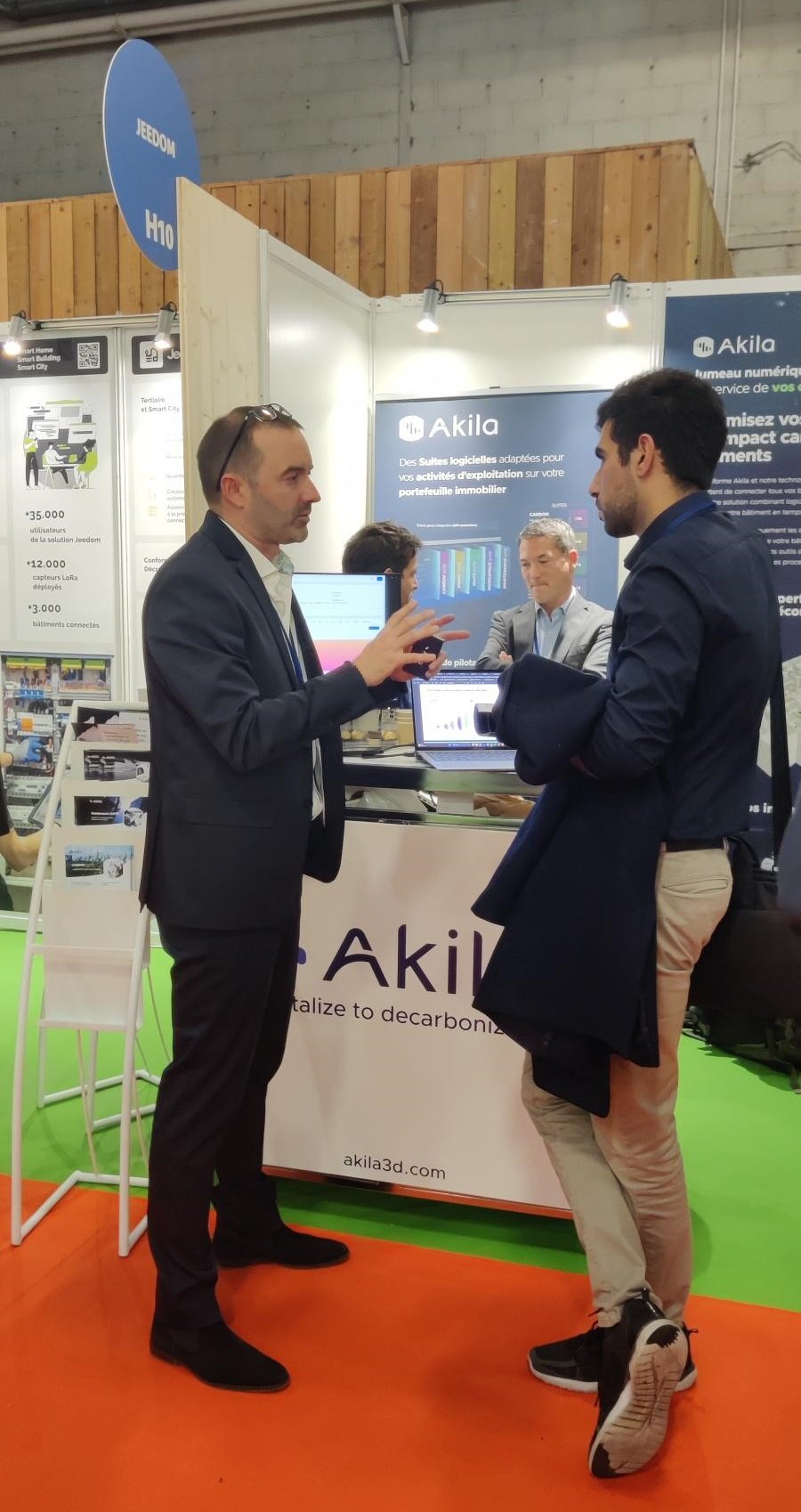
IMMODAYS & IBS

Akila attended two trade shows in November.

IMMODAYS in Deauville and IBS in Paris. It was a fantastic opportunity to connect and exchange ideas with leaders in the industry.

We wanted to thank everyone who attended, and took the time to visit us.
Whether it was in Deauville or in Paris, each interaction reinforced our passion for driving progress in the real estate and building sectors.

FPT partnership

This month, our Commercial leadership team also had the privilege of meeting with the chairman and executive teams of FPT Software, Tanihara Toru to launch an exciting collaboration focused on the Japanese market.

FPT is a major player in technology development and distribution across APAC, and their solution Vert Zero complements Akila’s mission to empower building owners and occupiers with smarter portfolio management solutions.

As a provider of advanced tools for carbon assessment and roadmap planning, Vert Zero complements Akila’s mission to empower building owners and occupiers with smarter portfolio management solutions. By integrating Vert Zero into Akila’s platform, we’re looking to bring even greater value to our customers, enhancing their capacity to track, optimize, and reduce their carbon footprint.

The partnership was officially sealed during a signing ceremony represented by Mr. Tran Duc Tri Quang, Data Director of FPT IS, and Mr. Philippe Obry, Vice President of Akila.

Looking forward to what we can achieve together!


NVIDIA x AKILA

Akila is proud to announce it is now a member of the NVIDIA Inception program, a program that nurtures startups revolutionizing industries with technological advancements.

With this program, Akila will have the opportunity to work with industry leading experts and other AI-driven organizations, to help bringing buildings to life digitally.

Akila is exploring the use of real-time realistic rendering, very large & dynamic models, natural language processing and other simulation tools appropriate for building operations.

Akila latest feature releases

Akila’s teams have been working hard this month to improve our platform and launch new features to help you with your work every day.

We have published a blog article about those new features, you can read more about it here.


SIMI 2024

Akila will be present at the SIMI, le salon de l’immobilier d’entreprise, in Paris from the 10th to the 12th of December.

Meet Pierre-Manuel Patry and Matthieu de Broca to discover how AKILA can improve your performance and accompany your decarbonation

Do not hesitate to book a demo today!


Palais des Congrès Porte Maillot

📍 NIVEAU 1 – B35.9 (Expertise Decarbonation)


Stay Connected with Akila on LinkedIn!

Want to stay updated on the latest news, innovations, and collaborations from Akila? Join us on LinkedIn!

Our LinkedIn page is the perfect place to learn more about our mission, explore our newest solutions, and to get the latest updates about Akila!

Don’t miss out—follow us on LinkedIn today and be part of the conversation on how to drive a sustainable future!


Related Articles
Akila x Milesight: Accelerating the AIoT Frontier for Smarter, Safer, Greener Spaces

Akila x Milesight: Accelerating the AIoT Frontier for Smarter, Safer, Greener Spaces

Smarter Manufacturing Starts with Unified Data 

Smarter Manufacturing Starts with Unified Data 

HVAC and IEQ: The Hidden Backbone of Global Logistics 

HVAC and IEQ: The Hidden Backbone of Global Logistics 

Take the next step with Akila

If you want better from your buildings, our team is here to help. Let’s set up a call to discuss your needs and show you how Akila works, from deploying digital infrastructure to optimization.

910-Product-page
Secondary ~ Request Demo Simple

Akila latest features

November 25, 2024

Akila is always developing new solutions to enhance operational efficiency and user experience.

Our teams have been working on several new features and improvements across our platform, suites and mobile app.

Here’s a closer look at what’s new in Akila and how these features can empower your workflows.

Akila New Features

Platform

Password Expiry

Passwords are now set to expire after 90 days, ensuring updates of your credentials to maintain system access and uphold security standards.

Linking Alarms to Work Orders

Add work orders on the Alarm Log page, this will enable you to close the loop on actions related to alarm resolution, and to provide additional details to on-site personnel.

The increased transparency and traceability in handling alarm logs ensures that all relevant personnel have access to the most up-to-date information.

Low Stock Alarms

Alarms can be added on the Alarm Configuration page to receive notifications when stock parts are low. This will not only alert you when inventory levels are depleted, but also plays a crucial role in maintaining seamless operations by ensuring a consistent and sufficient supply of parts.

By streamlining inventory management, it reduces downtime, and supports proactive restocking strategies, ultimately contributing to cost savings.

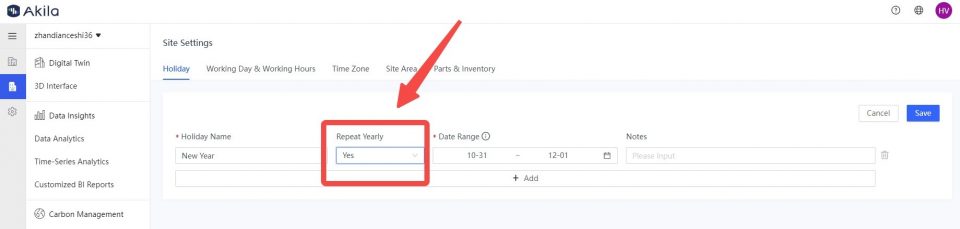
Annually Repeating Holidays

You can now set holidays to repeat annually on the Site Settings page, allowing for better planning and management of inspection schedules during holiday periods and saving configuration time.

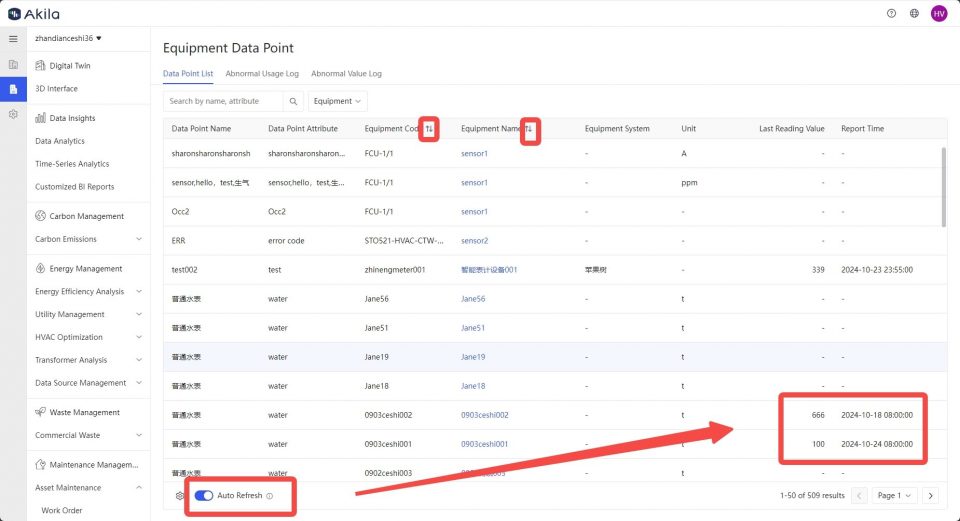
Real-time Data Point

Real-time data points are now accessible by clicking “Auto Refresh” on the “Data Point List” tab of Equipment Data Point page. With the click of the “Auto Refresh” button, you can also experience seamless, automatic updates to the data, enabling swift identification of any abnormal conditions.

Energy

Portfolio Energy Monitoring

A client-level user can now view cross-site energy data to compare the energy usage of different monitoring objects across different sites on the Portfolio Energy Monitoring page.

This is configured by linking monitoring points to monitoring objects on the Monitoring Point Configuration page, enabling the calculation and comparison of energy usage across various monitoring objects. You can also click “Sync Daily Usage” to sync the meter’s historical usage and daily usage to view the data more quickly.

Portfolio Energy Monitoring offers multidimensional search capabilities, enabling you to swiftly analyze and compare the energy performance of different monitoring objects, thereby enhancing operational efficiency.

Digital Twin

Real-time Equipment Status Monitoring

Equipment statuses can now be monitored within the Digital Twin page. This new functionality allows for continuous oversight of equipment status, enabling proactive measures to inspect equipment, maintain product line quality, and ensure on-site security.

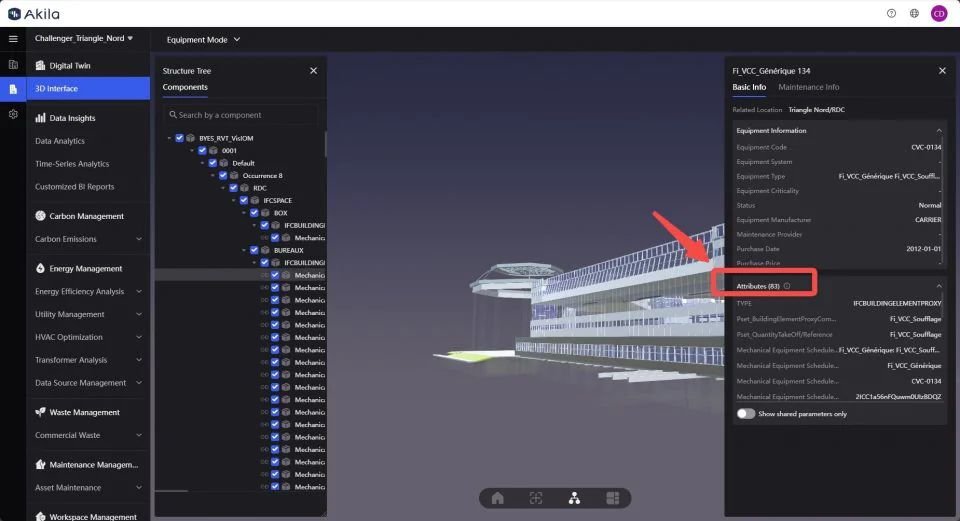
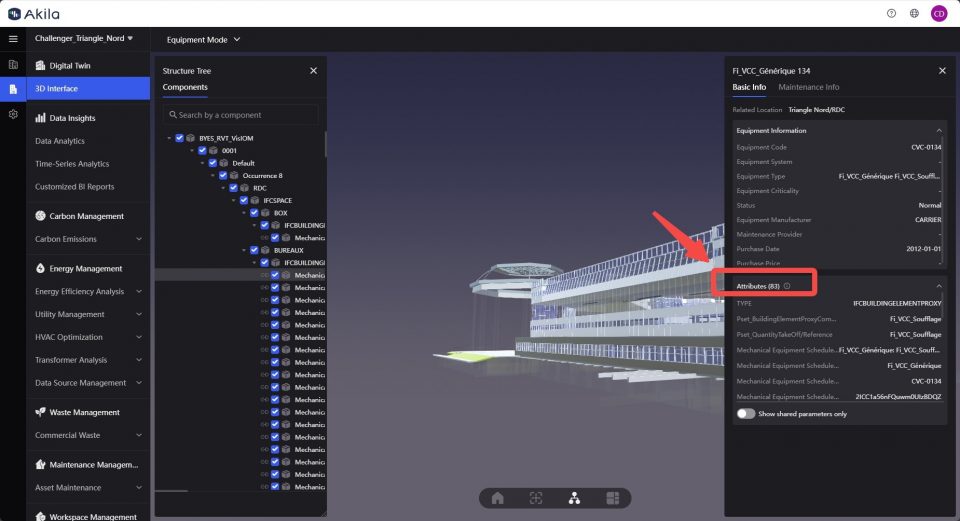
Display Equipment Attributes from BIM

The attributes and parameters of equipment are now available from the BIM Model to get more specific information on the Digital Twin page.

Maintenance & Workspace

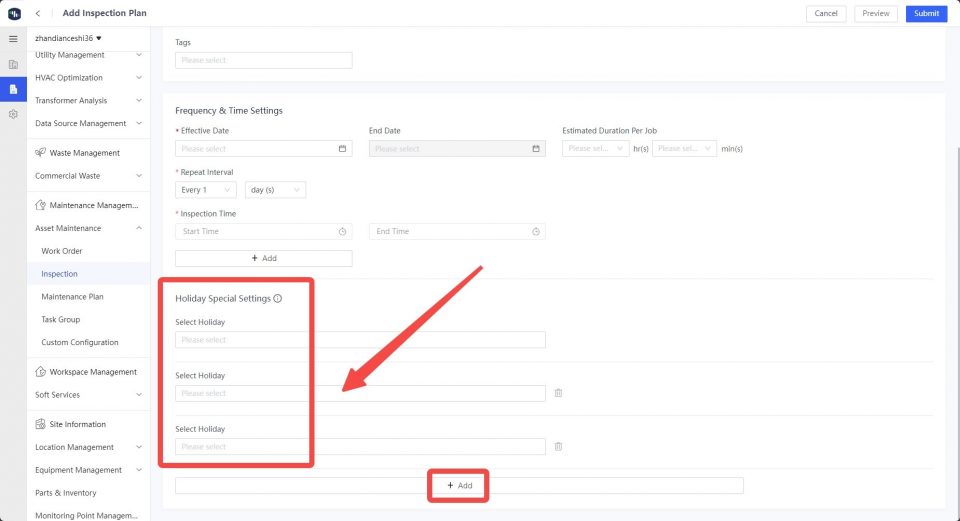
 Support Different Holiday Settings in a Plan

 You can now set various holidays when adding or editing an inspection plan, allowing the plan to accommodate specific configurations for multiple holidays.

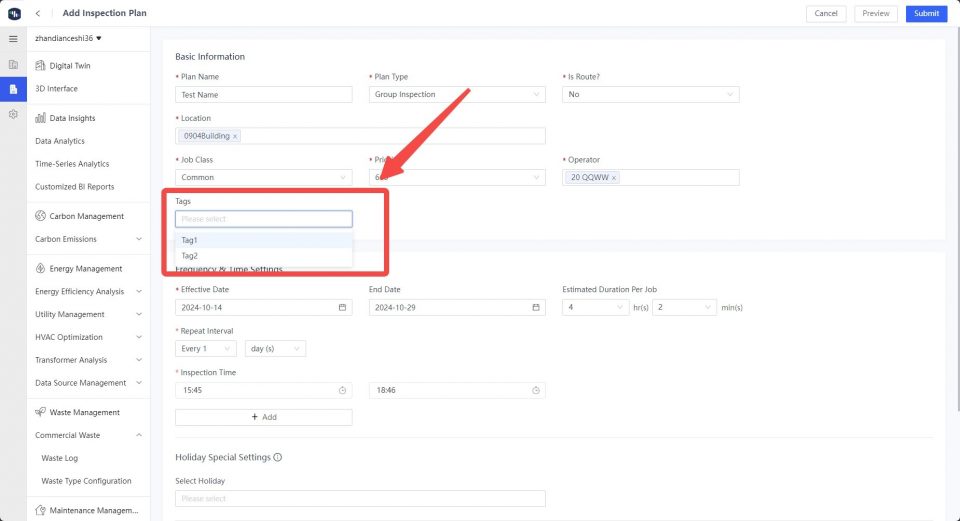
Show Inspection Plan Tag

Adding and assigning unique tags to different inspection plans is now available, similar to the categorization system used for work orders. In this way, it improves the manageability of inspection plans, especially for sites with a high volume of inspections, saving time for operators.

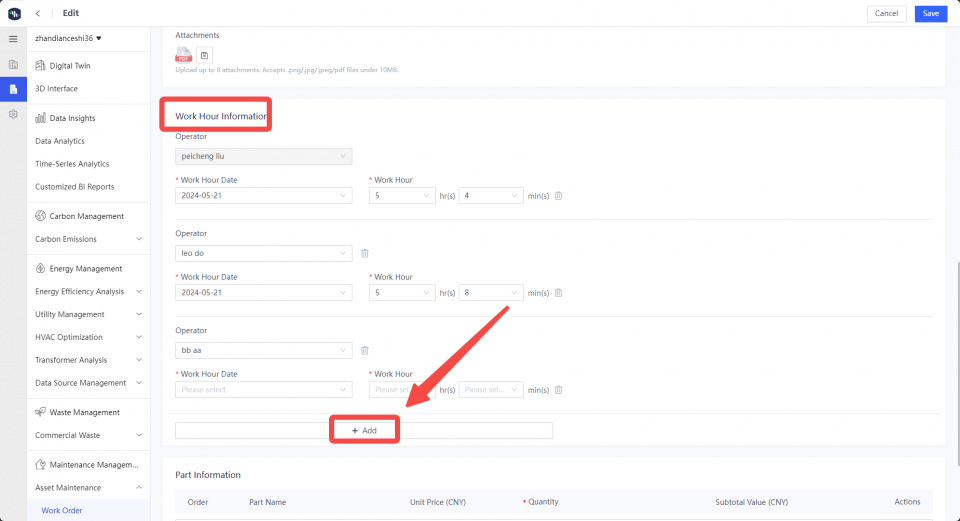
Log Working Hours

You can now add the related working hours when editing work orders. In the past working order execution progress, maybe some un-assigned operators will help to carry out work orders and their working hours are not logged. With this feature, their working hours can be logged, enabling a comprehensive life-cycle work order log.


Mobile App New Features

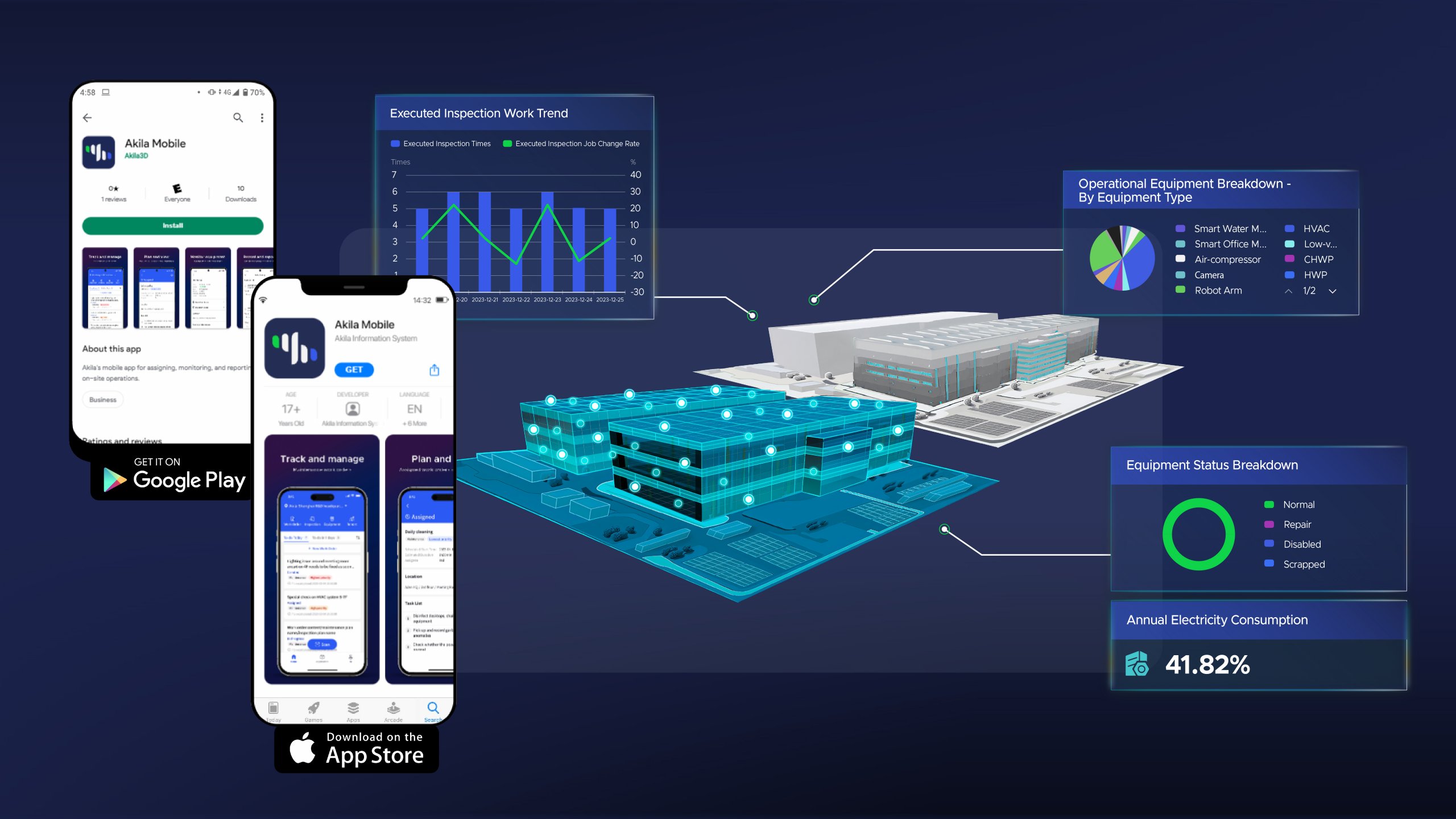
The Akila app is available for iOS and Android users.

Maintenance and Workspace

Alarm Log

The App now includes Alarm functionality, offering real-time updates about equipment issues, which supports various condition-based maintenance scenarios.

Immediate Job Visibility

After scanning the QR code of a location or equipment, operators can quickly identify tasks that can be started immediately in the Today’s To-do list, as well as from the equipment details page. The list will be automatically sorted by their scheduled completion time, ensuring efficient planning and execution of tasks.

Offline Inspection Custom Tag

This new feature allows you to view unique tags to offline inspection plans, similar to the categorization system used for work orders. It improves the manageability of inspection plans, especially for sites with a high volume of inspections, saving time for operators.

Global Android Push Notification

Global Android user can now receive banner notifications from Akila, which help them to get the work order or inspection related information in time, enabling quick actions on dealing with work orders and inspections.


Akila Features’ Improvements

Platform

Extended Regional Support for AI Applications

The Akila AI Assistant and Long-term Energy Usage Forecast features are now available in the French region!

Energy

Energy Monitoring Chart Enhancements

The energy monitoring chart has been enhanced by introducing “Totals” and “Details” modes that enable swift access to essential data. Updates include breakdowns by monitoring points across multiple time-granularities, full-screen mode for enhanced presentations, and adjustable window sizing for more convenient analysis.

Maintenance & Workspace

Editable Work Order Type and Job Class

We have introduced an update that allows for the customization of default work order and job class types. You can select both work order type and job class type on a single page when assigning or re-assigning work orders, streamlining the configuration process and saving time


With these updates, Akila is smarter, faster, and more user-friendly than ever!

Our teams have been working on these new features to make your job easier: we want to help boost your efficiency and simplify your workflows.

Have a look at those improvement and see the difference for yourself – Akila’s got you covered!


Related Articles
Akila Mobile is now available on iOS and Android

Akila Mobile is now available on iOS and Android

Feature focus: Akila Energy Savings Tracker

Feature focus: Akila Energy Savings Tracker

Energy SUITE: dedicated tools for decarbonization

Energy SUITE: dedicated tools for decarbonization

Take the next step with Akila

If you want better from your buildings, our team is here to help. Let’s set up a call to discuss your needs and show you how Akila works, from deploying digital infrastructure to optimization.

910-Product-page
Secondary ~ Request Demo Simple

Akila Monthly Recap : September

September 30, 2024

What an amazing month of September has been for Akila!

We’ve had so many exciting things happen, and we couldn’t wait to share them with you.

Here are some of the key moments:

Climate Week Success

We had such a great time at Climate Week! A big thank you to everyone who stopped by for our demo.

Akila’s Mark Bawtree and John D’Angelo – Managing Director of Deloitte also hosted a session on “Technology innovation in the built environment”.

It was amazing to connect with so many passionate people working toward a sustainable future.

South Beach partnership

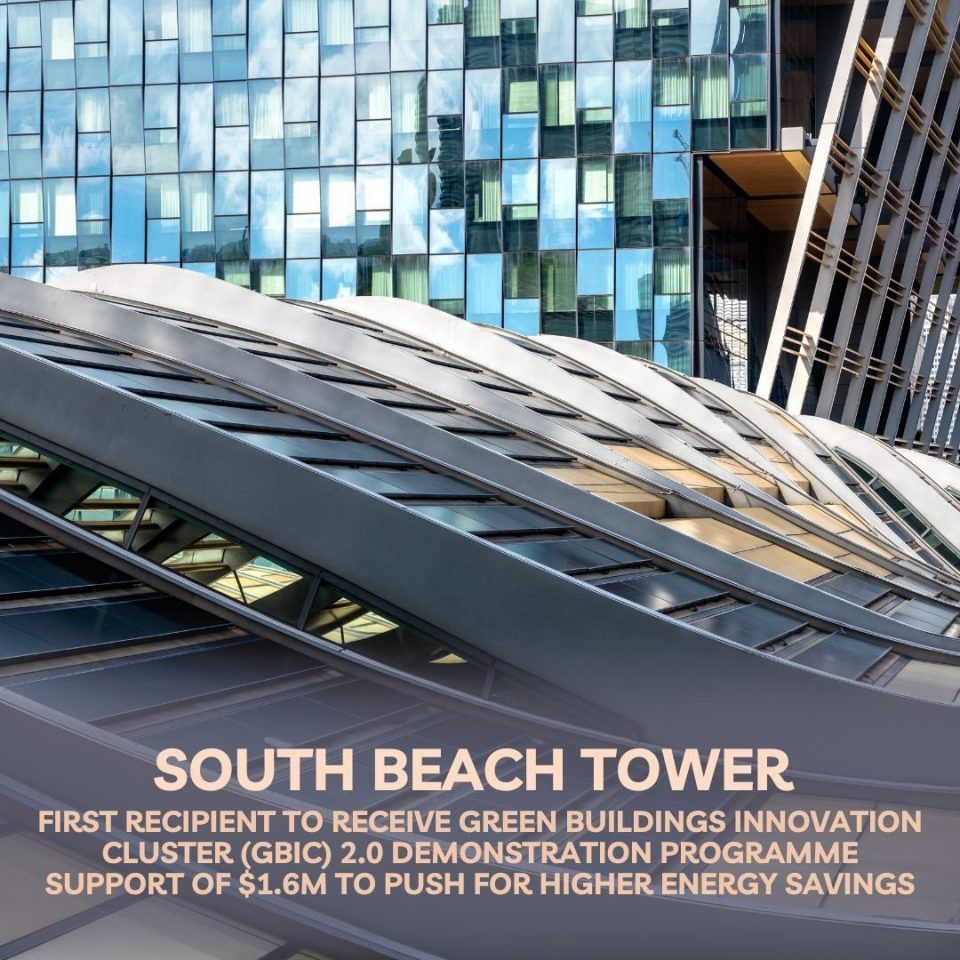
You might have already seen the news, but Akila has partnered with South Beach as part of our big move into Singapore! Together, we’re using our digitalization solution to future-proof their building. Big things ahead!

Read more about it here.

Webinars

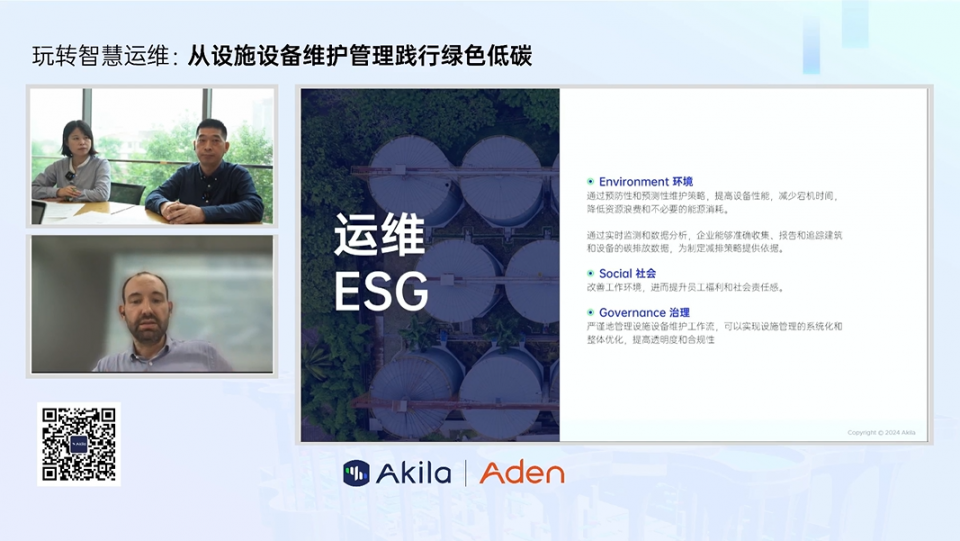
We also held a successful webinar in China, Guillaume Gimonet – Head of Technical Service Solution at Aden and Peter Gao – Senior Solution Consultant discussed “Mastering smart operations and maintenance: How to practice green and low-carbon from facility equipment maintenance management”.

We’re looking forward to our next webinar next month that will be held by Johnny Li – Akila’s Customer Success Manager.
Stay tuned for details, and thank you to everyone who participated in our previous sessions!

App Launch

Akila Mobile is now live on iOS and Android!

You can download it on the App Store/Google Play today to explore all the features designed to enhance your experience.

Akila & PTIT faculty of IT cooporation

This month, Akila also had the opportunity to visit the faculty of Information Technology 1 at PTIT in Vietnam. Led by our Vice President, Philippe Obry, this meeting was a pivotal moment in fostering international partnerships: we shared our latest innovatitions in energy optimization, while the faculty showcased their impressive expertise and commitment to sustainable development. Together, we explored potential synergies between PTIT’s research initiatives and our technological advancements. This collaboration marks the start of a promising journey that will benefit both Akila, PTIT, and the wider community!

Featured Blog Post

Lastly, don’t miss Mark Bawtree’s latest blog post on Unlocking the power of digital twins, where he discusses their role in enhancing operational efficiency in buildings. It’s a must-read for anyone interested in the future of digital tech.

You can check it out here.

Thank you for your continued support – we’re glad to have you with us.

Exciting things are coming for Akila in the next months, and we can’t wait to share them with you!

Related Articles
Meet Akila: Cynthia Yuan, Head of Digital Engineering

Meet Akila: Cynthia Yuan, Head of Digital Engineering

 Akila at the AI-xperience Forum in Amsterdam

 Akila at the AI-xperience Forum in Amsterdam

Akila Joins NVIDIA Partner Network: Advancing AI-Native Digital Twins 

Akila Joins NVIDIA Partner Network: Advancing AI-Native Digital Twins 

Take the next step with Akila

If you want better from your buildings, our team is here to help. Let’s set up a call to discuss your needs and show you how Akila works, from deploying digital infrastructure to optimization.

910-Product-page
Secondary ~ Request Demo Simple

How Akila goes beyond a BMS, EMS, or CMMS with digital twin technology

February 14, 2023

Akila digital twin vs BMS

Quick links
What is a BMS?
What is an EMS?
What is a CMMS?
What makes Akila different?


Building automation has come a very long way over the years to become what we now refer to as “smart building” technology. Smart buildings leverage a whole range of technology solutions such as Building Management Systems (BMS), Energy Management Systems (EMS), Computerized Maintenance Management Systems (CMMS), and more to make the day-to-day operation of facilities more efficient.

These technologies have been able to achieve some amazing things on their own already: more control, less waste, better data, and more optimized operations and costs.

So, what makes Akila different?

In simple terms, Akila is bigger than any individual system. It is an all-in-one digital twin platform for buildings, integrating every system and sub-system into a single source – removing silos and contextualizing each part, process, and performance in relation to the whole.

The Akila digital twin is designed to work with a whole range of hardware and thus is much more flexible and customizable than typical BMS and EMS software. Furthermore, Akila can go beyond just linking all systems at the individual building level to include an entire property portfolio in the same platform. The level of deep data and scalable deployment provided by Akila is what our customers leverage to optimize ESG performance.

Let’s break it down by each different system to see where Akila excels versus traditional tech.

What does a BMS do?

A Building automation system (BAS), building control system (BCS), and building management system (BMS) are three terms that often get thrown around and can cause some confusion. They are the same thing. BAS, BCS, and BMS can all be used interchangeably to refer to the same technology.

BMS is a computer-based control system installed in buildings that control and monitors different systems in a building. The BMS system typically integrates multiple systems such as heating, ventilation, air conditioning, lighting, and security into a unified system. This centralized control allows for efficient management of the building’s energy consumption, improves the indoor environment, and helps to ensure the safety of the building’s occupants.

Akila building management system functionality

BMS functionality in Akila

The BMS can also be programmed to perform specific tasks automatically, such as reducing the operation of different subsystems during unoccupied periods, and can be accessed remotely for monitoring and control.

Systems controlled by a BMS include (but are not limited to):

  • HVAC
  • Steam
  • Hot water and central heating (boilers)
  • Cold water and cooling system (chillers)
  • Fire protection system
  • Electricity monitoring system (EMS)

The number of subsystems connected to the BMS, and the level of control can vary based on the needs of the facility. Most of the time, however, the primary systems controlled by a BMS are HVAC and electrical systems.

Akila vs BMS

Akila brings in the functionality of a BMS and goes even further beyond. We build upon the useful features of a BMS and pair them with a full-picture system that includes more in-depth looks at the inter-relation of different systems and the operations surrounding them. Akila then leverages this BMS data to help businesses meet their sustainability, efficiency, and ESG goals.

For example, when Akila was deployed in a multi-site project for Ikea China, the existing buildings were already using a BMS. These were integrated into the Akila platform, where the data was centralized along with other sub-system data to provide a full-picture look at the site’s performance. Using Akila as a single source of truth led to improved efficiency and a resulting reduction in energy use.


Register for a demo

What does an EMS do?

An Energy Management System (EMS) is a software platform that monitors and controls an organization’s energy usage. The EMS allows organizations to track their energy consumption, identify areas for improvement, and implement energy-saving strategies. The system can integrate with various building systems, such as lighting and HVAC, to provide a comprehensive view of energy usage.

The best use of an EMS is to monitor systems and identify anomalies in energy use. An EMS can identify where and how energy is being wasted. It can measure energy use against a baseline and alert operators when it goes off track. It can also simulate energy use in different scenarios to help with planning operations or projects.

Akila vs EMS

Akila can provide all the functions of an EMS through just one software suite: Akila Energy. Akila Energy then works in tandem with other software and hardware (such as BMS and maintenance functions) to provide energy-specific data relating to equipment and operations. This also includes micro-grid assets, such as on-site solar panels and energy storage batteries.

One of the most important energy-related features of Akila is the ability to track energy savings and measure greenhouse gas impact based on Scope 1, 2, and 3 emissions categories. This information is critical when it comes to ESG reporting. Akila allows our customers to use the time normally spent on collecting data to act on improving their emissions impact.

Solar microgrid managementSolar microgrid management

What does a CMMS do?

A Computerized Maintenance Management System (CMMS) is a software application used to manage maintenance operations and track equipment maintenance. The system provides a centralized database to store maintenance records, schedules, and history and enables the efficient planning and execution of maintenance tasks. CMMS can automate tasks such as work order generation, scheduling, and resource allocation, and can generate reports to provide valuable insights into maintenance operations.

By reducing manual processes and providing real-time data on maintenance activities’ status, CMMS can help organizations improve equipment reliability, reduce downtime, and lower maintenance costs. Additionally, CMMS can help organizations comply with industry regulations and standards, such as OSHA, by providing a clear record of maintenance activities.

Akila vs CMMS

Akila can also be used as a CMMS by maintaining asset registers and related maintenance plans, technical history, and inspection records. In the maintenance sphere, Akila is designed for practical usage, compliance, and direct work feedback from technicians (via the Akila App). By leveraging data captured from other software modules, third-party monitoring systems, and predictive algorithms (within Akila or from our partner ecosystem), the maintenance program can be adjusted in near real time to the actual condition of the built environment and its usage.

What makes Akila different?

The Akila platform encompasses all the systems mentioned above. It exists vertically above all of them – not adjacent to them. While Akila can accommodate these existing systems, and even help clients to set up the infrastructure for them, the real value is to bring all these data sources together into a single platform.

Using Akila as the single source of truth to contextualize all processes, systems, and data not only offers more transparency when it comes to reporting but also enables stakeholders and decision-makers to act more effectively. The goal of each one of these systems is to increase efficiency, reduce costs, or cut emissions or waste. Even if used to the full extent, most of these systems still exist in data or operational silos. Akila brings it all into the same playing field.

Furthermore, Akila is not limited to a single building. Akila’s full potential is unleashed when used to manage an entire portfolio. This is where the most value can be gained for company leaders. Akila can provide investment-grade data to be used for ESG and compliance reporting. It also allows the director and c-suite level decision makers to visualize how their properties are performing across an entire market, region, and globe at the click of a button.

Related Articles
 Akila at the AI-xperience Forum in Amsterdam

 Akila at the AI-xperience Forum in Amsterdam

Akila x Belimo: A Strategic Collaboration for Smart, Sustainable Buildings

Akila x Belimo: A Strategic Collaboration for Smart, Sustainable Buildings

Australia’s Climate Disclosure Law Is Here — And the Net Is Tightening 

Australia’s Climate Disclosure Law Is Here — And the Net Is Tightening 

Take the next step with Akila

If you want better from your buildings, our team is here to help. Let’s set up a call to discuss your needs and show you how Akila works, from deploying digital infrastructure to optimization.

910-Product-page
Secondary ~ Request Demo Simple

Feature focus: Real-Time Weather Data Energy Simulation

May 05, 2022

Feature: Real-Time Weather Data Energy Simulation
Module: Akila Energy
Key benefits:

  • Uses live weather data to accurately project energy usage
  • Augments energy savings tracker with more reliable baselines
  • Provides up to 40% increase in energy simulation reliability

Bridging the gap between the simulation and the real world

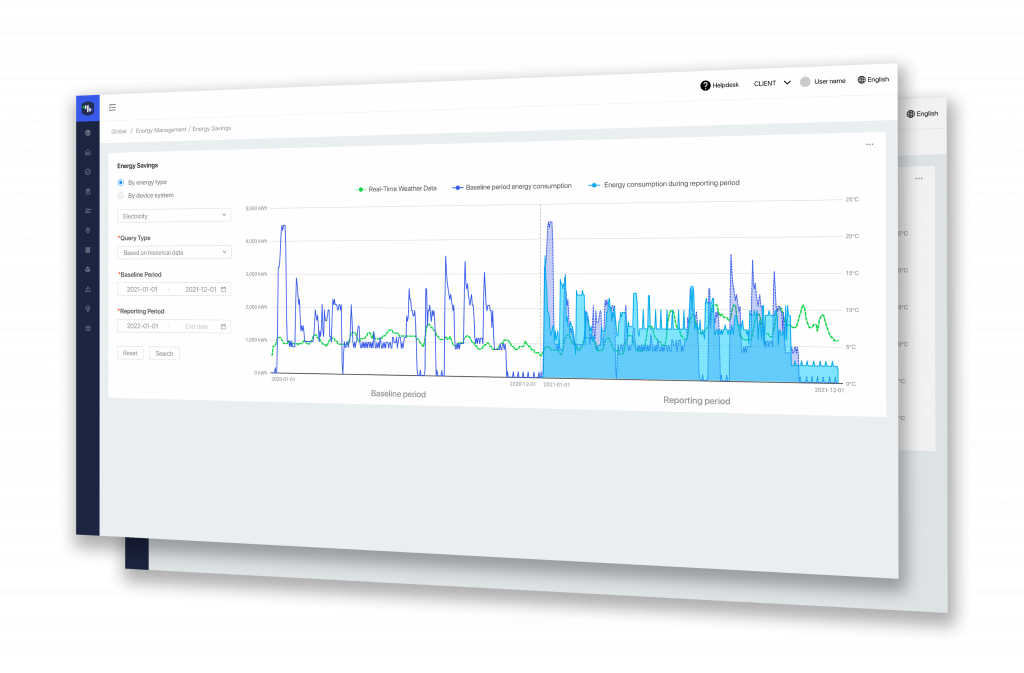
Using real-time weather data, Akila is now able to augment building energy use simulations and improve their accuracy, providing clearer and more realistic baselines. Calibrating simulation models is a significant challenge, and using the wrong data can impact accuracy. Models may never conform exactly to reality—the best laid plans oft go awry—but when augmented with real, operational data, models become a valuable tool to generate insight.
Akila Energy’s simulation functions are tailored with real-time data and cutting edge methods to provide insights and opportunities to optimize facility operations. Using historical performance, these tools take advantage of real-world, historical performance data and use them to plan for future operations.

An ugly duckling grows up

In new construction projects, simulation models are often discarded after the design process. This is because historically accepted levels of certainty for building energy simulations are at about 68%—meaning the model can be trusted about 2/3 of the time. These lenient requirements are due to the fact that in the design stage, there’s no operational data to calibrate the model—only historical data from other designs. Because of this, simulation has a reputation as being the ugly duckling of the construction process. How can these models’ usefulness outlive construction?

The answer is, you might have guessed—more data. Real, operational data. Carrying forward the models, designs, and data from planning to operation in a building’s lifecycle is a core principle of greenfield digital twin solutions. This enhanced digital thread, a living digital record of a building can be continually augmented, turning unreliable early-stage simulations into accurate pictures of optimal facility operations. With improved data visibility and access, energy savings programs and ESG goals are more easily achieved.

Why weather data?

Simply put, because HVAC systems are typically the biggest single source of energy usage in a building. For a company energy efficiency that means they’re also major cost and emissions centers. Using the Akila platform, energy savings, emissions savings, and financial savings, are all visible within the energy dashboard.

Calibrating energy simulation requires data about the environment outside the facility.

Traditionally, historical climate data is plugged in to calibrate the simulation—but heating and cooling are done in response to weather, not climate. Using live data, fed from local weather stations, energy simulations can become increasingly exact.

Accurate Information, Quick Reactions, Better Solutions

An important part of any energy savings program is building a reliable baseline of operational energy use. But a baseline can only show you progress. A simulation reveals the goal of optimal operational efficiency.

This new extension of the Energy Savings Tracker submodule is a marked improvement in accuracy for a building’s energy simulation, making it more reactive and realistic. Recent studies have shown improvements exceeding 40% when implementing live weather data over historical data. A simulation that’s closer to reality is a better picture of an optimal functioning building—letting stakeholders see more clearly how energy savings projects are performing.

With the advantage of guideposts behind and in front, in the form of baseline and simulation, Akila offers an unparalleled advantage—targeting with precision and accuracy energy-saving goals. In order to meet these goals, a holistic view is required. At a facility level, targets might be missed. Yet diagnosing the facility-wide shortfall requires system and asset level simulation—the Akila platform allows for simulation to be done at this granular level to find critical inefficiencies.

Akila means powerful simulation tools to optimize operations

As we continue to add features in the future, Akila will improve and extend existing simulation features, including acoustic, vibration, and airflow simulation to enable more accurate fault detection within the Asset module, improved environmental quality in operational settings, and accurate energy tracking. Akila will simplify the management of both maintenance and energy reduction, while continually expanding the opportunities for users to measure and document their carbon reduction and overall operations efficiency.

Related Articles
Akila at the World Economic Forum: Driving the Future of Digital Twin Innovation

Akila at the World Economic Forum: Driving the Future of Digital Twin Innovation

Akila and Dassault Systèmes Announce Virtual Twin-Based Cooperation for the Built Environment ESG Performance

Akila and Dassault Systèmes Announce Virtual Twin-Based Cooperation for the Built Environment ESG Performance

Enersize and Akila sign exclusive partnership for Asia market

Enersize and Akila sign exclusive partnership for Asia market

Take the next step with Akila

If you want better from your buildings, our team is here to help. Let’s set up a call to discuss your needs and show you how Akila works, from deploying digital infrastructure to optimization.

910-Product-page
Secondary ~ Request Demo Simple

Feature Focus: Energy Finance Dashboard

April 18, 2022

At A Glance

  • Portfolio-wide view of financial savings from energy optimization projects
  • Calculates using real-time data based on local and sector-specific pricing data
  • Energy efficiency projects’ ROI can now be viewed and reported down to the asset level

Introducing the Energy Finance Dashboard

As businesses and governments across the world embark on their journey to net-zero carbon emissions, energy optimization is a top item on every business agenda. Simply put: if you are doing energy efficiency right, you are also boosting your financial efficiency. And the more the interplay of energy and financial savings can be quantified and documented, the more breathing room portfolio managers enjoy to pursue ambitious roadmaps for net-zero carbon and the overall sustainability of their buildings.

Unfortunately, due to the complexity and frequent changes in energy pricing, comprehensively measuring the ROI of energy efficiency projects is often a pain point. Even today, many companies are limited to a side-by-side comparison of monthly utility bills, a mechanism that opens companies to human error and major challenges implementing at scale.

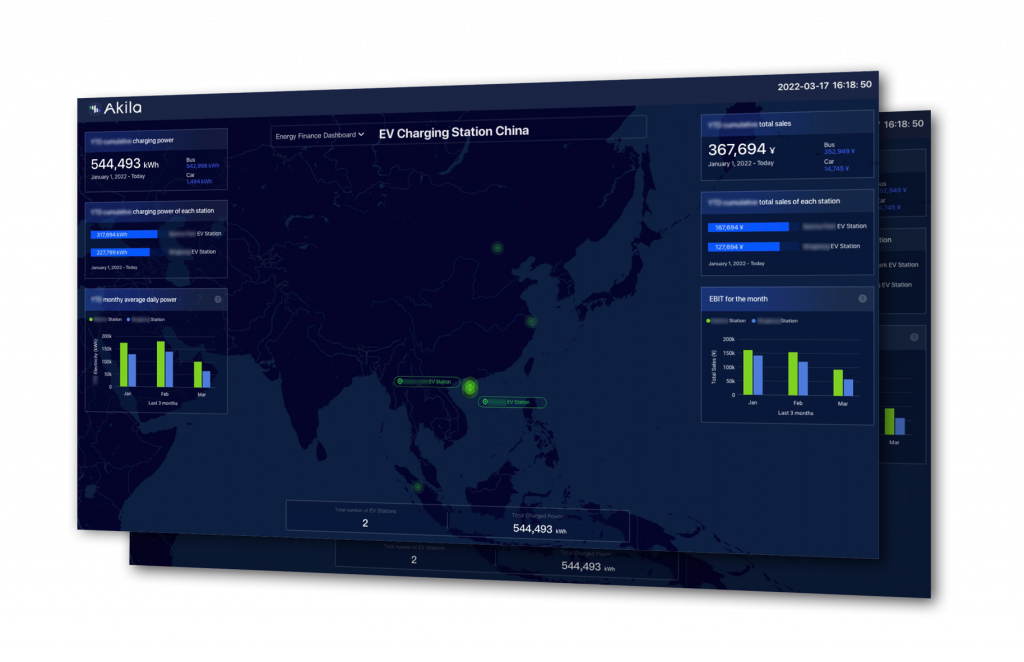
This is why Akila is excited to announce the launch of its Energy Finance Dashboard, the newest addition in a suite of portfolio-performance cockpits in the Akila platform. The Energy Finance Dashboard calculates cost savings portfolio-wide, down to the level of individual pieces of equipment, based on real-time data, AI-based analytics and specific utility rates for each site, based on local regulations and pricing.

What has been holding portfolio managers back?

Energy pricing is a notoriously complex thing to track, subject to a wide range of variables even within one jurisdiction. Time of day or year, regional regulations, industrial sector and energy type are just some of the areas where pricing routinely differs. For portfolio managers, this creates enormous headaches and the challenge of reliably tracking this only grows when extended across regional and national borders.

As mentioned earlier, many companies have been limited to measuring financial returns through a simple comparison of monthly energy billing. While this method may give a view of the overall trend, it does not provide anywhere near the depth needed – no reliable way to zoom in and attribute improvements to specific changes made in a specific building, floor, or piece of equipment. Equally, managers have no way to identify the under-performing elements in their portfolios and quickly make the changes needed to boost savings and cut carbon.

How the Energy Finance Dashboard changes the equation

The Energy Finance Dashboard is built on three pillars, which allow an unprecedented level of detail and management.

Energy baseline and efficiency tracking: Akila creates a fully transparent energy baseline and tracks the actual progress of an energy efficiency project, offering an equipment-level view of each energy-consuming asset. This provides granular, real-time data which allows automated tracking of costs inside the Akila platform.

Energy Pricing submodules: Not as technical as it sounds. In simple terms, Akila is set up to calculate and automatically adapt its calculations based on local pricing and regulations. So, if energy prices surge or drop for your facility in one city, this will be recorded and factored in without skewing the data from facilities in other locations.

Cross-border data standardization: As discussed in previous posts, portfolio managers have a notoriously difficult time standardizing their energy data, which tends to disappear into vast spreadsheets where errors and oversights multiply. Because Akila creates a single, standardized source of truth for data, and is already deployable across China and Southeast Asia, complex and rock-solid ROI calculations can be made in real-time, empowering stakeholders to make better decisions, faster.

Akila Dashboards: expanding the toolkit for transparency and benchmarking

Energy Finance is the newest entry in a fast-growing set of dashboards designed to give stakeholders deeper insight and control over the performance of their portfolios and net-zero roadmaps. Other dashboards include:

ESG Dashboard

Combining energy, water, GHG and waste reporting, in line with GRI frameworks for reporting, customizable to a client’s needs.

Asset Dashboard

Real-time, high-level KPI data for maintenance, in line with global standards for reporting

Energy Dashboard

Granular, equipment-level views of near-real-time energy use and efficiency gains, in line with IPMVP standard.

Related Articles

Akila named Microsoft IP Co-Sell Ready Partner

Local Law 97 (LL97) and the new compliance era for US buildings

Local Law 97 (LL97) and the new compliance era for US buildings

Why Chiller-Side Optimization is Key for HVAC Efficiency

Why Chiller-Side Optimization is Key for HVAC Efficiency

Take the next step with Akila

If you want better from your buildings, our team is here to help. Let’s set up a call to discuss your needs and show you how Akila works, from deploying digital infrastructure to optimization.

910-Product-page
Secondary ~ Request Demo Simple

Feature focus: Akila Energy Savings Tracker

March 16, 2022
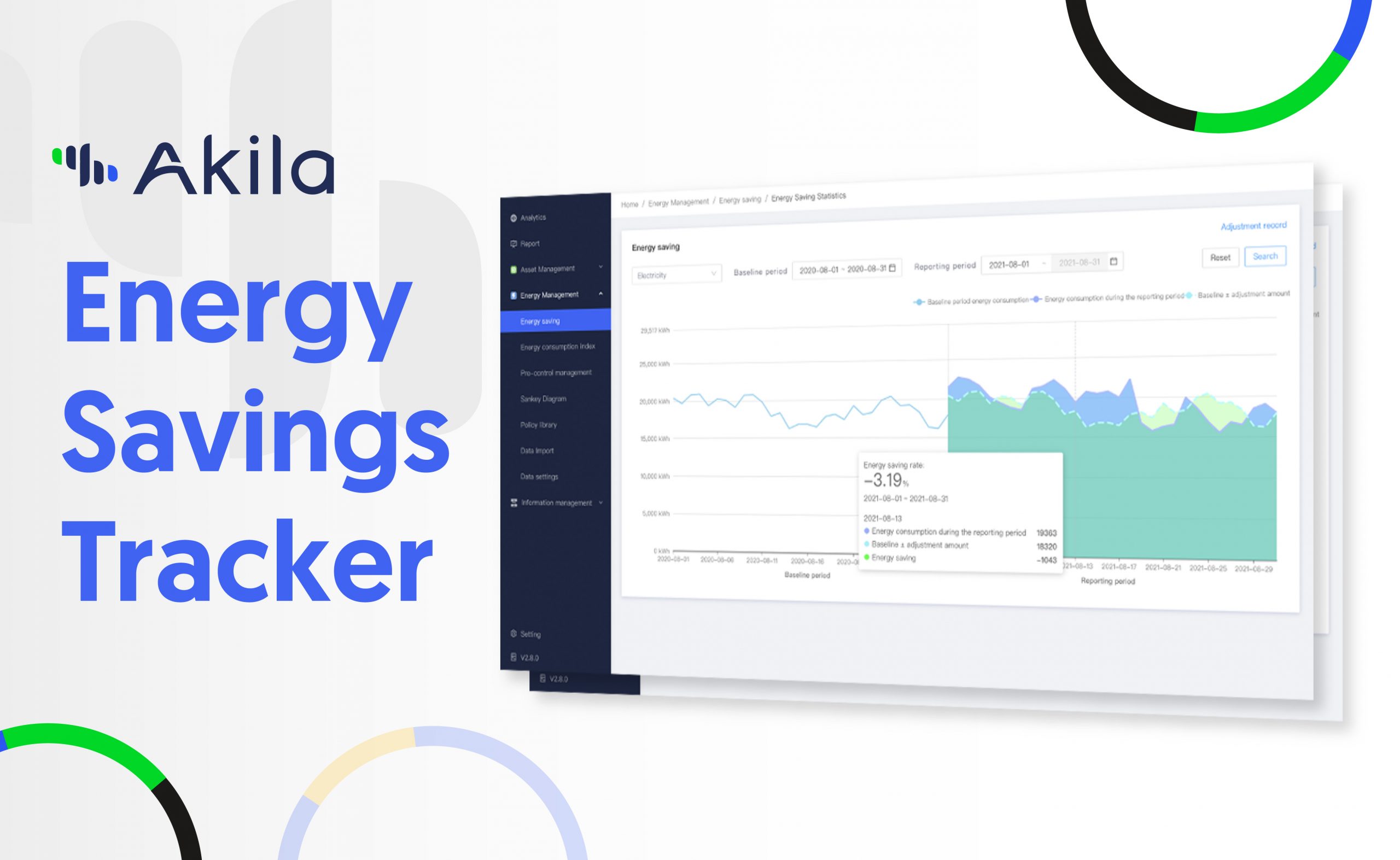
Akila Energy Savings Tracker platform image

Feature: Energy Savings Tracker
Module: Akila Energy

Key benefits:

  • Designed according to internationally recognized standards (IPMVP)
  • Automated calculation and display of carbon impact
  • Granular (equipment-level) measurement of energy use and savings
  • Live data collection, with continual feed into user dashboard and analytics.

What doesn’t get measured doesn’t get managed

Everyone knows that energy savings and carbon-cutting go hand-in-hand. But practical experience shows that many companies with the best intentions and most ambitious targets often fall into traps along the way to optimization.

For starters, there is the initial challenge of getting a verifiable baseline of energy consumption – a measure of how much energy your facilities, assets and equipment are consuming before the energy optimization project kicks off. Then, there is the matter of systemically measuring the impact of changes you have made. This is no small task considering the number of systems, pieces of equipment and the sheer volume of the data involved.

The fact is that many companies with the best of intentions remain held back by the limits of their data measurement and validation infrastructure. This is precisely the type of challenge Akila and its Energy Savings Tracker is designed to overcome.

Spreadsheets aren’t up to the job   

As much as data technology has advanced, a surprisingly high percentage of energy optimization projects are still recorded and measured through Excel or a similar spreadsheet program. This is far from ideal and creates a number of vulnerabilities for project managers and their companies:

Delays between measurement and action: The complexity and slow speed of data collection and entry limits companies to only periodic measurement and analysis of their data. Energy inefficiency may still be spotted, but only after a period of unnecessary waste and carbon production.

Difficulty scaling: Without the right platform, each measurement you add requires an upping of time and resources, while also increasing the risk of error (see the below).   

Difficulty zooming in: It’s one thing to see overall consumption, but what about pinpointing or comparing performance in individual pieces of equipment. This can be done in a spreadsheet, but it’s hardly user-friendly and done less often for just this reason.

Hard to validate and spot errors: Simply put, spreadsheets have no smart or automated way to validate the accuracy of the data they contain and major limitations on automated updating of data. Accuracy in this system comes down to human effort and talent, which comes under more and more strain as the number of assets, systems and facilities being measured grows.

Akila’s Energy Savings Tracker: a smarter, simpler way to measure impact

There is a better way and it is already operational on the Akila platform. In fact, the team at Akila just upgraded Energy Savings Tracker’s feature set, enabling Akila users to have a dramatically more accurate, granular and streamlined view of their energy savings data.

1. Compliant with international standards

The Energy Savings Tracker is designed for systemic compliance with the standards of IPVMP (International Performance Measurement and Verification Protocol), which is considered the international gold standard for energy efficiency projects. This means that whether users are reporting emissions for local government compliance, or to global HQ in another country, your data will be valid, verified and recognized.

2. Set a comprehensive, digitalized baseline

There are two main ways to set a baseline, and Akila integrates both through our simulation technologies and energy-specialist network.

  • Historical data: any records already existing, energy billing records, historical meter data etc. This typically requires an audit and involvement from our energy specialists in order to gather data and build a model inside the platform.
  • Simulated data: Smart modelling to calculate your predicted energy use and expected performance of your building.

3. Real-time data and analytics in a user-friendly dashboard

Akila gives facility and portfolio managers a central location for all this data, with clear carbon and energy-efficiency assessments from the level of whole portfolios, individual facilities (very important for benchmarking if you have a large portfolio) and individual chillers, boilers., etc.

Because Akila tracks your data in a live feed located right in the dashboard, alongside analytics, users can look at energy use across any time frame, with any level of granularity. From the whole system to a single boiler, from peak load to downtime, from an hour to a year—Akila’s Energy Tracker enables users to accurately assess the energy and carbon impact of their projects. 

A growing toolkit for savings tracking

As we continue to add features in the future, Akila will strengthen its integration of its equipment-tracking and CMMS features, allowing for fault detection and smart diagnostics on equipment and assets. Akila will simplify the management of both maintenance and energy reduction, while continually expanding the opportunities for users to measure and document their carbon reduction and overall.

Related Articles
Monthly Recap : November

Monthly Recap : November

Akila Featured in Singapore’s Ecosperity Conversations: Powering Smart Decarbonization at South Beach Tower

Akila Featured in Singapore’s Ecosperity Conversations: Powering Smart Decarbonization at South Beach Tower

HVAC efficiency in a time of energy shortages and insecurity

HVAC efficiency in a time of energy shortages and insecurity

Take the next step with Akila

If you want better from your buildings, our team is here to help. Let’s set up a call to discuss your needs and show you how Akila works, from deploying digital infrastructure to optimization.

910-Product-page
Secondary ~ Request Demo Simple